

 Español
 Русский
Ecuador Food Exports and Key Products for B2B Buyers
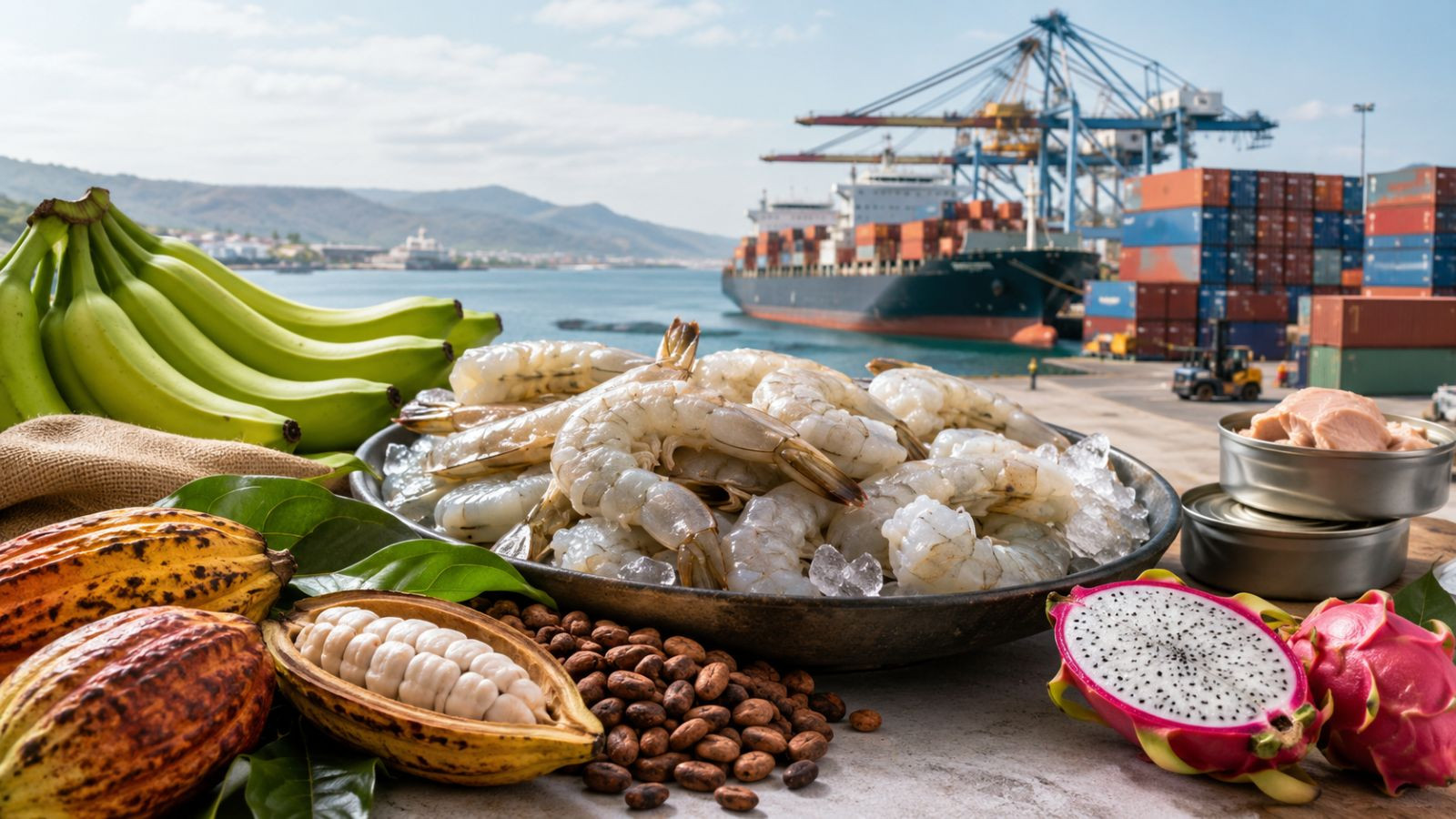
Ecuador holds a significant position in global food trade thanks to several major export sectors. In 2025, shrimp became the country's largest export by value, cocoa overtook bananas, and banana exports approached 7 million metric tons. Canned fish, tuna, and tropical fruits also play an important role. For international buyers, Ecuador's appeal lies not in a single specialization but in its combination of aquaculture, tropical agriculture, and a well-developed processing industry geared primarily toward China, the United States, and European markets.
Key Facts
- Ecuador's total merchandise exports reached $37.15 billion in 2025, with non-oil exports accounting for $29.40 billion.
- Shrimp exports reached $8.40 billion and exceeded oil exports by value for the first time.
- Cocoa and cocoa products generated $4.67 billion, while bananas and plantains accounted for $4.26 billion.
- Bananas remain the country's largest food export by physical volume, at nearly 7 million metric tons for the year.
- The United States and China together accounted for 42.4% of Ecuador's total non-oil exports in 2025.
Exports in Numbers
Banco Central del Ecuador does not publish a separate official aggregate for "food exports," so the most accurate approach is to compare the main food-related product categories individually.
| Category | Exports in 2025 | Change vs. 2024 |
| Shrimp | $8.40 billion | +20.2% |
| Cocoa and cocoa products | $4.67 billion | +29.0% |
| Bananas and plantains | $4.26 billion | +11.0% |
| Canned fish | $1.85 billion | +10.3% |
| Fruit | $494 million | +33.1% |
| Tuna and fish | $348 million | +4.5% |
| Coffee and coffee products | $151 million | +3.8% |
Source: Banco Central del Ecuador.
Data for the first half of 2026 show that the export structure continues to shift. Shrimp exports increased by a further 10.4% compared with the same period in 2025, while banana exports rose by 6%. In contrast, the export value of cocoa fell by 57.5% amid lower global prices. The record cocoa figures of 2024-2025 therefore should not be treated as a sustainable price level.
Main Export Products
Shrimp
Shrimp aquaculture has become Ecuador's central export industry. In 2025, the country exported approximately 1.4 million metric tons of shrimp worth $8.4 billion. China and the United States are the largest markets, while substantial volumes also go to Europe. For buyers, key factors include product format, size grading, processing facility, lot origin, and maintenance of an uninterrupted cold chain.
Cocoa
Ecuador is a major global supplier of cocoa beans and processed cocoa products. In 2025, exports in this category reached $4.67 billion. Export value, however, is highly sensitive to global commodity prices. The rapid increase seen in 2024-2025 was followed by a significant decline in 2026. For B2B sourcing, buyers should focus more on specific origin, crop year, quality, and lot specifications than on the headline value of Ecuador's national cocoa exports.
Bananas and Plantains
The banana sector remains Ecuador's largest food export flow by tonnage. Shipments reached nearly 7 million metric tons in 2025. The main production areas are located in the coastal provinces of Los Ríos, Guayas, and El Oro, providing convenient access to maritime terminals. Export markets are diversified across the United States, Europe, Russia, the Middle East, and other destinations.
Tuna and Canned Fish
Ecuador also has a substantial fish-processing industry. Canned fish exports reached $1.85 billion in 2025, with a further $348 million recorded in the separate tuna and fish category. The European market is particularly important. According to industry data, the EU accounts for a significant share of canned seafood sales. For buyers, raw-material origin and traceability carry greater importance here than in most plant-based commodity trades.
Tropical Fruits and Coffee
Fruit exports remain smaller than Ecuador's main commodity sectors but are growing faster than many of them. In 2025, export value increased by 33% to $494 million. Banco Central del Ecuador identifies pitahaya, mango, and naranjilla among the expanding products. Coffee occupies a more specialized position, with exports of coffee and coffee products totaling approximately $151 million.
Main Export Markets
Market geography varies by product. Across all non-oil exports in 2025, the largest destinations were the United States at $6.57 billion and China at $5.92 billion, followed by the Netherlands, Spain, and Russia. Together, the United States and China accounted for more than 42% of non-oil exports.
Individual product categories show different patterns. China is especially important for shrimp, while European and U.S. markets are significant for bananas. Cocoa is shipped to the United States and Europe as well as to major processors in Asia. Supplier evaluation should therefore focus not on Ecuador's overall export geography, but on the supplier's actual experience with the specific product and destination market.
How the Logistics Network Works
Most food exports move by sea through Ecuador's Pacific ports. Guayaquil and the deepwater terminal at Posorja play key roles, while Puerto Bolívar and Manta are also important for certain cargo flows.
Posorja continues to expand its container and reefer capacity, while Guayaquil's port infrastructure is equipped to handle perishable products.
An uninterrupted cold chain is critical for shrimp and frozen fish. Bananas and fresh fruit require controlled temperatures, reliable transit times, and proper container condition. Cocoa and canned products are less temperature-sensitive but still require protection from moisture, correct loading procedures, and preservation of lot identification throughout the supply chain.
What B2B Buyers Should Consider
Before signing a contract, buyers should verify the supplier's legal entity, export registration, actual production or packing capacity, and track record in shipping the required product.
Exports are processed through SENAE and the ECUAPASS system. Plant products are subject to Agrocalidad procedures, including phytosanitary documentation where required by the destination market. The specific set of permits and certificates depends on the product and importing country.
Product specifications should define quality parameters, origin, packaging, labeling, traceability, laboratory documentation, permitted tolerances, MOQ, Incoterms, and claims procedures before shipment. Certification alone does not replace verification of the specific lot and its export documentation.
Where to Find Suppliers
On AllFoods Market, buyers can browse food suppliers from Ecuador and individual product categories, including shrimp suppliers from Ecuador, Ecuadorian cocoa suppliers, Ecuadorian banana suppliers, and pitahaya suppliers.
The next level of content should examine production, export statistics, seasonality, specifications, and sourcing requirements for each of these products separately.
FAQ
What food products does Ecuador export?
Ecuador's largest food export sectors include shrimp, cocoa, bananas and plantains, canned fish, tuna, and tropical fruits. In 2025, shrimp became Ecuador's largest export product by value.
What is Ecuador's largest food export?
By value, shrimp ranked first in 2025, with exports of approximately $8.4 billion. By physical volume among the main food categories, bananas and plantains ranked first at nearly 7 million metric tons.
Where does Ecuador export its food products?
Key international markets include the United States, China, and European countries. Export geography varies considerably by product. China is particularly important for shrimp, while bananas and seafood products have strong positions in European markets.
What documents are required to source food products from Ecuador?
Documentation requirements depend on the product and destination country. The standard export procedure is handled through SENAE and ECUAPASS, while plant products may require phytosanitary procedures through Agrocalidad. Before concluding a transaction, requirements should be verified for the specific HS code and importing market.
Sources and Data
- Banco Central del Ecuador, foreign trade and product export data for 2025.
- Banco Central del Ecuador, geographic distribution of non-oil exports.
- Servicio Nacional de Aduana del Ecuador, export procedures.
- Agrocalidad, phytosanitary export procedures.
- Cámara Nacional de Acuacultura, shrimp export statistics.
- INEC, banana production statistics.
- CEIPA, fish-processing export statistics.
AllFoods Market: Latest Blog Posts
-
Top 10 Supermarket Chains in Austria: A Brief Overview
Austria’s grocery retail market brings together national chains, international groups, discounter...
-
Top 10 Supermarket Chains in Belgium: A Brief Overview
Belgium’s grocery retail sector brings together national chains, international groups, discounter...
-
Olive Oil Producers in Spain for B2B Sourcing
Spain's olive oil sector combines cooperative mills, industrial processors, refiners, bottlers, a...
-
Top 10 Largest Grocery Chains in Italy
Italy’s grocery market is divided among cooperative groups, national supermarket brands, internat...
-
Top 10 Largest Grocery Chains in Sweden: A Brief Overview
An overview of Sweden's largest grocery retail chains, including store formats, geographic covera...