

 Español
 Русский
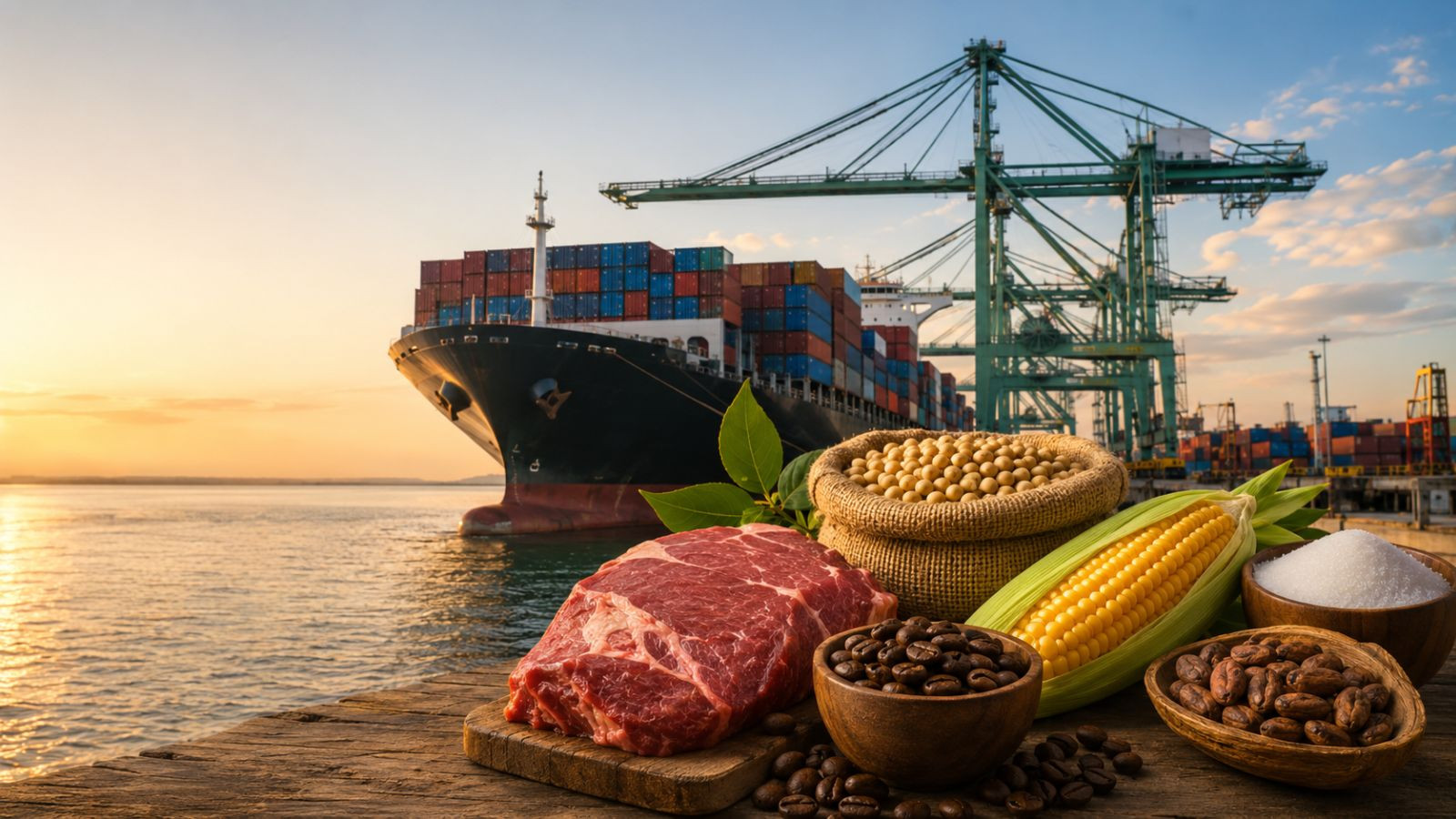
Brazil Food Exports
Brazil is one of the world’s leading suppliers of agricultural products. In 2025, Brazilian agribusiness exports reached $169.2 billion, accounting for 48.5% of the country’s total merchandise exports. Behind that headline figure, however, are very different markets: soybeans and corn move in large bulk vessel shipments, meat depends on a well-developed cold chain, coffee is more sensitive to quality and price cycles, while fresh fruit serves a different buyer base and requires a different logistics model. For international buyers, Brazil is particularly attractive because it combines scale, diversification, and established export infrastructure.
At a glance
- Brazilian agribusiness exports totaled $169.2 billion in 2025.
- The soybean complex, the largest category, generated about $52.9 billion.
- Beef exports reached approximately $18 billion, while coffee exports were about $16 billion.
- China accounted for 32.7% of Brazilian agribusiness exports, and the EU for 14.9%.
- Brazil’s export system relies on Santos and Paranaguá in the south and southeast, as well as the growing northern Arco Norte corridor.
Brazil’s exports in figures
It is important to distinguish agribusiness exports from strictly food exports. Official MAPA statistics also include forestry products, fibers, and other non-food goods within the agribusiness category. The $169.2 billion figure therefore cannot be treated entirely as “food exports.”
| Category | 2025 exports | Change |
| Soybean complex | $52.9 billion | -1.9% |
| Beef | ~$18.0 billion | +40.1%* |
| Coffee | $16.1 billion | +30.3% |
| Sugar and ethanol | $15.1 billion | -23.5% |
| Chicken meat | $9.79 billion | -1.4% |
| Pork | $3.62 billion | +19.3% |
| Fresh fruit | $1.45 billion | +12% |
* According to ABIEC data. Other product groups may use a slightly different AgroStat classification.
Main export products
Soybeans and soybean products
The soybean complex remains the largest segment of Brazilian agribusiness exports. In 2025, its exports were valued at $52.9 billion, representing roughly one-third of the country’s total agribusiness exports. Soybean exports alone reached a record 108.2 million metric tons, worth $43.5 billion. China is a particularly important market, so buyers need to monitor not only Brazil’s crop yields but also shifts in Asian demand.
Beef and other meats
Meat was one of the main drivers of export growth in 2025. According to ABIEC, beef exports reached 3.5 million metric tons and $18.03 billion. Brazil also exported 5.324 million metric tons of chicken meat worth $9.79 billion and 1.51 million metric tons of pork worth $3.62 billion. For international buyers, critical factors include the approval status of the specific processing plant, market access protocols for the destination country, veterinary documentation, and cold chain integrity.
Coffee
In 2025, the export value of the coffee sector rose to approximately $16.1 billion, even though physical shipment volumes declined significantly. Industry association Cecafé recorded exports of 40.05 million 60-kg bags and record revenue of $15.59 billion. This illustrates how strongly export value depends on global prices, crop availability, and quality grades, rather than shipment volume alone.
Sugar and corn
Brazil remains a major supplier of sugar and grains despite a decline in sugar export value in 2025. Sugar accounted for more than 90% of the export value of the sugar and ethanol complex. Corn is the dominant product within the grain segment. For these commodities, buyers need to pay particular attention to FOB pricing, port of loading, inland transportation from production regions, and the availability of vessel-sized lots during the required shipment window.
Fruit
Fresh fruit represents a significantly smaller export value than soybeans or meat, but it offers a distinct opportunity for food importers. In 2025, fresh fruit exports reached a record $1.45 billion, increasing by about 12% in value and nearly 20% in physical volume. Brazil’s export portfolio includes melons, mangoes, grapes, avocados, and other crops.
Where Brazil exports its agricultural products
China remains Brazil’s largest market. In 2025, it imported $55.3 billion worth of Brazilian agribusiness products, equivalent to 32.7% of total sector exports. The EU accounted for $25.2 billion, or 14.9%, while the United States represented about $11.4 billion, or 6.7%.
The product mix varies by destination. China is particularly important for soybeans and meat. The European market plays a major role in coffee, soybean products, and certain processed foods. Meat, sugar, grains, and other categories are also widely distributed across the Middle East, Asia, Africa, and Latin America. For this reason, a supplier’s dependence on a specific market is better assessed at the product level rather than from aggregate country statistics.
How export logistics work
In Brazil, inland transportation can be almost as critical as ocean freight. Major production regions are located hundreds and, in some cases, thousands of kilometers from the coast.
Santos remains one of the main export hubs for soybeans, corn, sugar, and containerized cargo. Paranaguá plays an important role in grains, soybean meal, and vegetable oils. At the same time, Arco Norte continues to expand: in 2024, about 34.8% of soybean exports and 46% of corn exports moved through this northern corridor, which connects inland production areas with river and seaport terminals in the Amazon basin.
Meat requires a strictly maintained refrigerated supply chain, while fresh fruit depends on rapid handling, temperature monitoring, and reliable container line schedules.
What B2B buyers should consider
Due diligence should begin not with Brazil’s broad reputation as an exporting country, but with the specific supplier and shipment specifications. Buyers should verify the corporate entity, its role in the supply chain, production assets, product origin, export track record, and actual capacity to supply the destination market.
For products of animal origin, buyers must verify the facility's registration status within the MAPA system and its specific export accreditation for the destination market. Plant products are subject to phytosanitary requirements and official certification. Detailed product specifications, laboratory parameters, packaging, labeling, traceability, Incoterms, and the port of shipment should all be formally agreed upon prior to contract execution. Requirements vary substantially by product category and target country.
Where to find suppliers from Brazil
AllFoods Market provides a dedicated Brazil regional directory featuring verified producers and products across the meat, coffee, seafood, and fruit sectors: Suppliers and manufacturers from Brazil on AllFoods Market.
For category-specific sourcing, buyers can browse targeted sections such as coffee from Brazil, frozen meat from Brazil, and melons from Brazil. Detailed sector reports on coffee, meat, sugar, soybeans, and fruit provide further in-depth analysis.
FAQ
What are Brazil’s top agricultural exports?
Within Brazil’s agri-food sector, soybeans and soybean products, beef, poultry meat, coffee, sugar, corn, and pork represent the largest categories. In terms of export value, the soybean complex remains the country’s single largest agricultural export.
Where does most of Brazil’s agricultural output go?
China is the largest individual buyer, accounting for 32.7% of Brazilian agribusiness exports in 2025. The European Union and the United States follow, though buyer distribution varies significantly depending on the specific commodity.
Which ports are most important for Brazilian food exports?
Santos and Paranaguá are key ports in the south and southeast. For soybeans and corn, the northern Arco Norte corridor and Amazon basin ports are increasingly critical, significantly reducing transit distances from key inland farming hubs.
What should buyers verify before sourcing food products from Brazil?
Buyers should verify the supplier's legal standing, producer credentials, shipment origin and technical specifications, destination-market export accreditation, packaging standards, traceability, and agreed Incoterms. Animal and plant products are governed by distinct regulatory compliance systems.
Sources and data
- MAPA AgroStat and agribusiness foreign trade statistics
- Ministério da Agricultura e Pecuária, 2025 Brazilian agribusiness export results.
- Instituto de Economia Agrícola, analysis of agribusiness foreign trade in 2025.
- ABIEC, 2025 beef export statistics.
- ABPA, 2025 poultry meat export statistics.
- Cecafé, 2025 coffee export results.
- Conab and Ministério de Portos e Aeroportos, data on agricultural logistics and Arco Norte.
AllFoods Market: Latest Blog Posts
-
Top 10 Supermarket Chains in Austria: A Brief Overview
Austria’s grocery retail market brings together national chains, international groups, discounter...
-
Top 10 Supermarket Chains in Belgium: A Brief Overview
Belgium’s grocery retail sector brings together national chains, international groups, discounter...
-
Olive Oil Producers in Spain for B2B Sourcing
Spain's olive oil sector combines cooperative mills, industrial processors, refiners, bottlers, a...
-
Top 10 Largest Grocery Chains in Italy
Italy’s grocery market is divided among cooperative groups, national supermarket brands, internat...
-
Top 10 Largest Grocery Chains in Sweden: A Brief Overview
An overview of Sweden's largest grocery retail chains, including store formats, geographic covera...