

 Español
 Русский
Argentina’s Food and Agricultural Exports
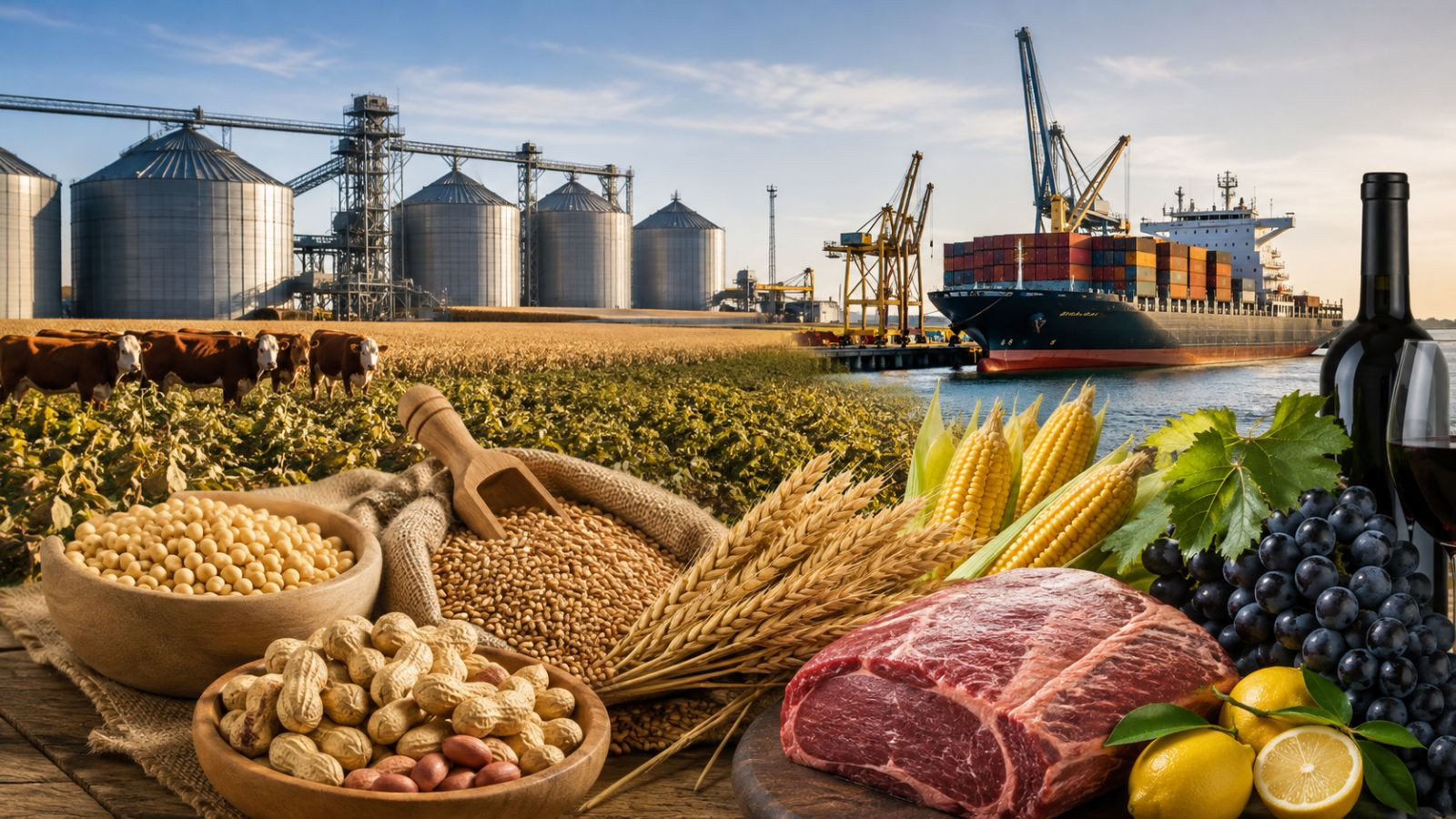
Argentina remains one of South America's leading agricultural and food suppliers. In 2025, the country exported $87.1 billion in goods, while agro-industrial exports reached $52.34 billion and a record 115.4 million metric tons. Soybeans and processed soy products, corn, wheat, beef, and sunflower products form the core of these shipments. But Argentina's export portfolio is much broader, with seafood, dairy products, peanuts, lemons, and other regional specialties also playing a significant role. For international buyers, factors such as seasonality, port of loading, destination market requirements, and the approval status of the individual facility can be just as important as price.
At a Glance
- Argentina's merchandise exports totaled $87.1 billion in 2025, up 9.3% from the previous year.
- Agro-industrial exports reached $52.34 billion and 115.4 million metric tons, accounting for about 60% of total merchandise export value.
- The soybean complex generated $21.44 billion, equivalent to 24.6% of the country's total merchandise exports.
- Among Argentina's major agricultural export complexes, sunflower and wheat recorded the fastest growth in 2025.
- For grains and oilseeds, Gran Rosario on the Paraná River remains the main logistics hub, handling roughly three-quarters of the country's corresponding port shipments.
Exports in Figures
| Category | 2025 Exports | Change vs. 2024 | Main Markets |
| Soybeans and derivatives | $21.44 billion | +9.2% | China, India, Vietnam |
| Corn | $6.66 billion | -8.3% | Vietnam, Peru, Malaysia |
| Beef | $4.34 billion | +28.4% | China, EU, United States |
| Wheat | $3.65 billion | +32.0% | Brazil, Indonesia, Bangladesh |
| Sunflower | $2.18 billion | +49.7% | India, Middle East, Europe |
| Fish and seafood | $2.09 billion | +3.9% | China, Spain, United States |
| Dairy products | $1.52 billion | +18.9% | Brazil, Algeria, Chile |
For comparability, the table uses INDEC's classification of export complexes. Sector-specific government agencies may publish slightly different figures because of differences in product coverage.
Main Export Products
Soybeans and Processed Soy Products
Soybeans form Argentina's largest agricultural export chain. One of the country's defining characteristics is the major role of processing: in 2025, approximately 40% of the soybean complex's export value came from meal and pellets, 34% from oil, and 23% from raw soybeans. As a result, destination markets vary by product. China is particularly important for soybeans, India for soybean oil, while soybean meal is sold to a broad range of buyers across Asia, Europe, and the Middle East.
Corn, Wheat, and Sunflower
Corn remains one of Argentina's largest export commodities, although its export value declined in 2025. Wheat moved in the opposite direction, rising to $3.65 billion, with Brazil remaining its key market. The sunflower complex grew even more sharply, reaching $2.18 billion, with oil accounting for the largest share. These supply chains depend on high-volume bulk logistics and require separate analysis of crop conditions, the export window, and shipment specifications.
Beef
Argentina's beef exports increased significantly in value in 2025, driven in large part by higher international prices. The market mix is diverse: China remains a major buyer, while the EU, United States, and Israel are also significant destinations. For B2B procurement, it is particularly important to verify not only the producer but also whether the specific establishment is approved to export to the intended destination market.
Fish and Seafood
Argentina's fish and seafood exports exceed $2 billion annually. In 2025, shrimp remained the largest product by export value, while squid exports increased sharply. China, Spain, and the United States accounted for more than half of the sector's export revenue. Cold-chain logistics, establishment approval, and the sanitary requirements of the destination market are critical for this category.
Dairy Products, Peanuts, and Regional Specialties
Argentina also exports milk powder, whey, and cheese. According to sector statistics, dairy export value reached $1.69 billion in 2025. The peanut complex exceeded $1.2 billion and is closely tied to the production cluster in Córdoba. Smaller in export value but internationally recognized categories include lemons and processed lemon products, wine, pears, honey, and yerba mate.
Main Markets
Argentina's export geography varies considerably by product. China is especially important for soybeans, beef, and seafood. India is a major market for vegetable oils. Brazil plays a key role in wheat and dairy exports. Vietnam has become one of the main destinations for grains, feed products, and other agro-industrial shipments.
Overall, China, Vietnam, Brazil, Peru, Saudi Arabia, Malaysia, India, Chile, Indonesia, and Algeria accounted for more than 58% of Argentina's agro-industrial export volume in 2025. For importers, this means concentration risk should be assessed at the level of the individual commodity supply chain rather than for the country as a whole.
Logistics
Most grain, soybean meal, and vegetable oil exports move through the Gran Rosario terminal system on the Paraná River. In 2025, Argentine ports shipped 100.2 million metric tons of grains, processed products, and oils, with the Gran Rosario area handling around three-quarters of the country's total flow in this category. Bahía Blanca and Necochea/Quequén form the second major export hub.
Containerized and temperature-controlled logistics are more important for beef, dairy products, fresh fruit, and seafood. Supply calculations should account not only for ocean freight but also for inland transportation from the processing facility, terminal handling, temperature requirements, and the availability of reefer equipment.
What B2B Buyers Should Consider
Before signing a contract, buyers should verify the seller's legal entity, the actual producer, product origin, and whether the facility is authorized to export the relevant category to the intended market. Product specifications, packaging, labeling, laboratory parameters, and traceability requirements should be agreed upon prior to shipment, not after the lot has been assembled.
Requirements for products of animal and plant origin vary by destination country. In Argentina, sanitary and phytosanitary controls are primarily governed by SENASA, while customs procedures involve ARCA and the Sistema Informático MALVINA. Some export procedures were updated in 2026, so documentation and establishment status should be rechecked immediately before concluding a transaction.
Where to Find Suppliers
AllFoods Market already features Argentine producers and suppliers of beef, frozen seafood, lemons, dairy products, berries, and yerba mate. The country page provides a convenient way to move from a market overview to specific companies and product offers.
Suppliers and producers from Argentina
Wholesale frozen meat
Wholesale frozen seafood
FAQ
What are Argentina's largest agricultural exports?
The soybean complex is the largest by export value. It includes not only soybeans but also soybean oil, meal, and other processed products. Corn, beef, wheat, and sunflower products also account for significant shares of agricultural exports.
Where does Argentina export food and agricultural commodities?
Key destinations vary by product. Major markets include China, Brazil, India, Vietnam, EU countries, the United States, Peru, Indonesia, and Algeria.
Which port is most commonly used for agricultural exports?
Gran Rosario on the Paraná River is the main hub for grains, meal, and vegetable oils. Depending on the product, exports also move through Bahía Blanca, Necochea/Quequén, ports in the Buenos Aires area, and specialized fishing ports.
What should buyers verify when sourcing food products from Argentina?
Buyers should verify the company and actual producer, product specifications, origin, lot details, packaging, traceability, and applicable sanitary documentation. For regulated products, it is also necessary to confirm separately that the establishment is approved to supply the destination market.
Sources and Data
INDEC, Argentina's export complexes for 2025
Secretaría de Agricultura, 2025 agro-industrial export results
Bolsa de Comercio de Rosario, 2025 port shipments
Bolsa de Comercio de Rosario, the role of Gran Rosario
AllFoods Market: Latest Blog Posts
-
Top 10 Supermarket Chains in Austria: A Brief Overview
Austria’s grocery retail market brings together national chains, international groups, discounter...
-
Top 10 Supermarket Chains in Belgium: A Brief Overview
Belgium’s grocery retail sector brings together national chains, international groups, discounter...
-
Olive Oil Producers in Spain for B2B Sourcing
Spain's olive oil sector combines cooperative mills, industrial processors, refiners, bottlers, a...
-
Top 10 Largest Grocery Chains in Italy
Italy’s grocery market is divided among cooperative groups, national supermarket brands, internat...
-
Top 10 Largest Grocery Chains in Sweden: A Brief Overview
An overview of Sweden's largest grocery retail chains, including store formats, geographic covera...