

 Español
 Русский
Food Exports from Venezuela
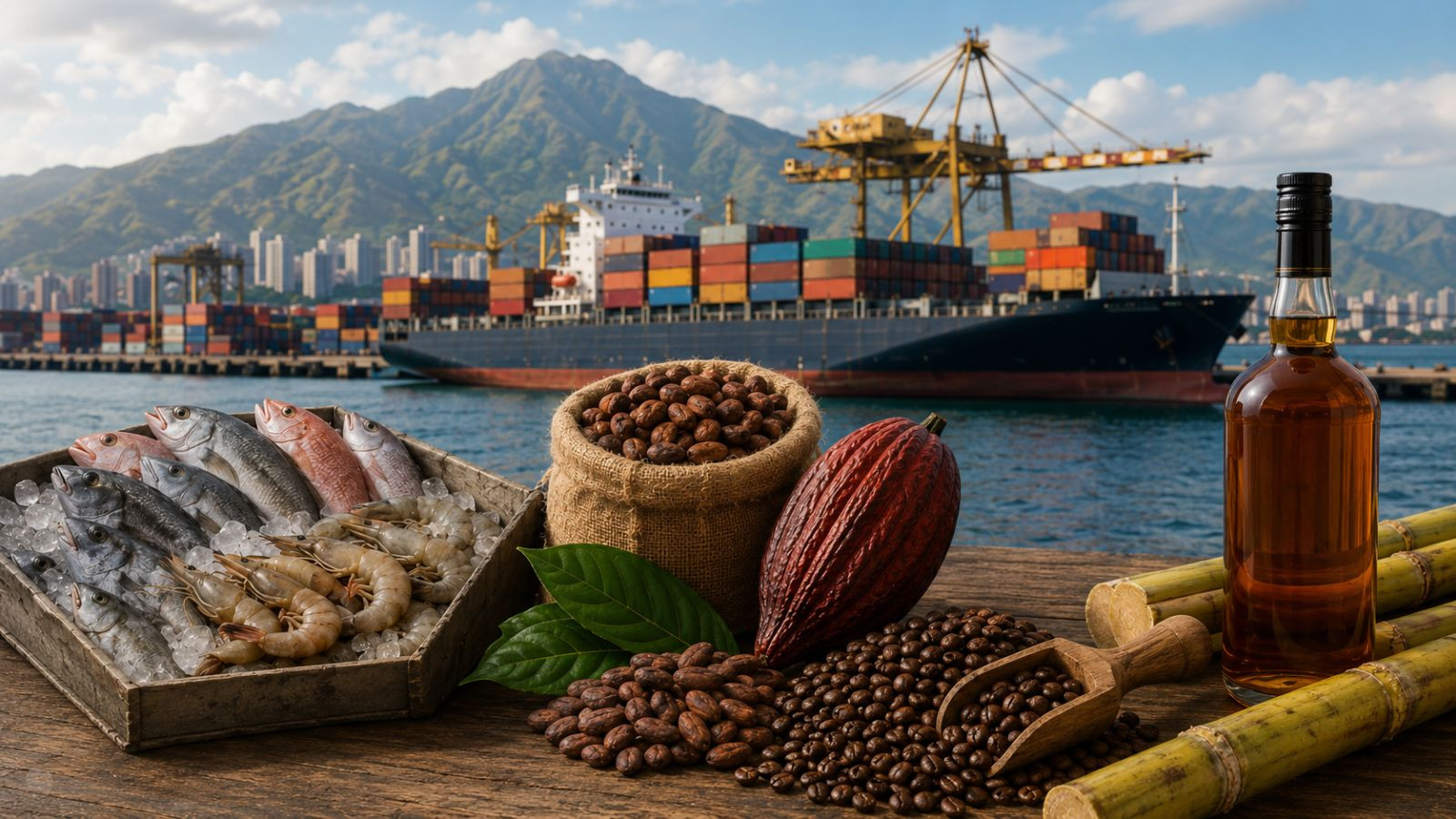
Venezuela is best known as an oil exporter, but the country has also developed several notable segments in international food trade. The most important are seafood, cocoa beans and processed cocoa products, rum, and coffee. According to USDA/FAS data, combined exports of agricultural products, seafood, and certain related product groups reached $775 million in 2025. The trade structure also changed significantly: seafood exports declined, while the value of cocoa bean shipments doubled over the year. For international buyers, Venezuela is primarily of interest in several specialized product categories rather than as a large-scale exporter of staple foods.
At a Glance
- Seafood remains the largest food export category, with exports of approximately $341 million in 2025.
- Cocoa bean exports reached $138 million, twice the 2024 figure.
- Exports of processed cocoa products totaled approximately $45 million.
- Distilled alcoholic beverages, primarily rum, accounted for approximately $64 million in exports.
- The European Union and the United States remain the largest destinations for agricultural and related products.
Exports in Figures
| Category | Exports in 2025 | Year-over-Year Change |
| Seafood | $341 million | -19% |
| Cocoa beans | $138 million | +100% |
| Distilled alcoholic beverages | $64 million | approximately 0% |
| Processed cocoa products and chocolate | $45 million | +24% |
The $775 million total export figure should not be interpreted as food exports alone. USDA/FAS statistics also include certain non-food product groups. For this reason, individual categories provide a more accurate basis for assessing Venezuela's food export market.
Main Export Products
Seafood
Seafood remains Venezuela's largest food export segment. In 2025, shipments totaled approximately $341 million, although this represented a 19% decline from the previous year.
Frozen shrimp are particularly important. The European Union is one of the main destination markets, with the Netherlands, France, and Spain playing notable roles within the EU. Large volumes are also shipped to China.
For importers, key considerations include product origin, the producing facility, processing conditions, sanitary documentation, and maintenance of the required temperature regime throughout the supply chain from the facility to the buyer.
On AllFoods Market, buyers can view suppliers of frozen seafood from Venezuela.
Cocoa and Processed Cocoa Products
Cocoa has become Venezuela's fastest-growing major export segment. The value of cocoa bean exports increased from approximately $31 million in 2023 to $69 million in 2024 and $138 million in 2025.
Chocolate and other processed cocoa products accounted for an additional approximately $45 million in 2025.
The increase in shipment value reflects not only higher export volumes but also elevated global cocoa prices. The main markets are located in Europe, North America, and Asia.
Venezuelan origin alone does not guarantee a particular quality level. Buyers should assess the specific lot, raw material origin, degree of fermentation, moisture content, defect levels, and traceability.
The category is represented in the AllFoods Market catalog under cocoa from Venezuela.
Rum and Other Alcoholic Beverages
Distilled alcoholic beverages generated approximately $64 million in export revenue for Venezuela in 2025. Rum is the principal specialized category within this segment.
The European Union and the United States remain the largest markets. Unlike cocoa, this product group has not shown similarly rapid growth in recent years. After reaching a higher export level in 2022, trade volumes stabilized.
For wholesale buyers, relevant considerations include product origin, aging, alcohol content, packaging format, trademark rights, and import requirements for alcoholic beverages in the destination country.
Coffee
Coffee still trails seafood and cocoa by a considerable margin in export value, but its role is gradually increasing.
Shipments of unroasted coffee to the United States have grown particularly noticeably. Their value was approximately $10 million in 2024 and approached $30 million in 2025.
At the same time, Venezuelan coffee exports remain volatile and vary significantly from year to year. A single strong season is therefore not yet sufficient evidence of sustained long-term growth.
Buyers should pay close attention to crop year, region of origin, bean moisture content, defect count, cupping results, and the ability to verify the origin of the lot.
Suppliers can be found in the coffee from Venezuela category.
Other Export Categories
Venezuela also exports sesame, pulses, and several other agricultural commodities in smaller volumes.
For example, significant shipments of sesame were exported to Mexico and Guatemala in 2024. These categories, however, remain much smaller than seafood, cocoa, and alcoholic beverages and do not define the overall structure of the country's food exports.
At the same time, Venezuela remains a major importer of staple foods, including wheat, corn, rice, vegetable oils, and dairy products. The presence of a product on the domestic market therefore does not necessarily mean that it represents a significant export specialization for the country.
Main Export Markets
Export geography varies substantially by product.
In 2025, the European Union accounted for approximately one-third of Venezuela's combined exports of agricultural and related products, while the United States represented around one-quarter. Japan and China also remained notable markets.
Europe is particularly important for shrimp, cocoa, and rum. The United States imports seafood, cocoa, coffee, and alcoholic beverages. Canada and selected Asian markets are also relevant destinations for cocoa.
Sesame follows a different trade pattern, with Mexico and Guatemala playing notable roles as destination markets.
Market assessment is therefore more accurate when export destinations are analyzed separately for each product category rather than relying solely on aggregate country-level statistics.
Logistics
Most Venezuelan food exports are transported by sea. The country's most important ports include Puerto Cabello and La Guaira. The Port of Maracaibo is also relevant for businesses located in western Venezuela.
Container shipping lines connect Venezuelan ports with major transshipment hubs in the Caribbean and ports in other regions. The specific route depends on the carrier, destination, and sailing schedule available at the time of shipment.
For frozen shrimp, fish, and other perishable products, buyers and exporters should confirm reefer container availability, the required temperature regime, equipment plug-in arrangements at the port, transshipment conditions, and total transit time before shipment.
For cocoa and coffee, protection against moisture, packaging condition, and correct cargo stowage inside the container are critical.
What Wholesale Buyers Should Consider
Supplier due diligence should begin with verification of the legal entity, the actual production facility, and the company's export track record.
Before signing a contract, the parties should agree on the exact product specification, origin, quality requirements, packaging, labeling, minimum order quantity, delivery terms, and required documentation.
Products of plant origin may require phytosanitary documentation issued with the involvement of INSAI. Fishery and aquaculture products fall under the regulatory authority of INSOPESCA. Additional sanitary requirements may apply to processed foods.
Requirements in the destination country must also be verified separately. An export authorization issued in Venezuela does not automatically mean that a product is admissible to the European Union, the United States, or another destination market.
For international payments, the banks involved, transaction participants, and any restrictions applicable to specific legal entities or payment routes should also be checked in advance.
Where to Find Suppliers
AllFoods Market lists Venezuelan producers and suppliers across individual product categories. For buyers, the catalog can serve as a starting point when sourcing seafood, cocoa, coffee, and other products.
After selecting a company, buyers should independently verify the facility, export history, documentation, and specifications of the particular lot. A supplier profile does not replace commercial and technical due diligence before a transaction is concluded.
FAQ
Which food products does Venezuela export the most?
Seafood remains the country's largest food export category, particularly shrimp. Cocoa beans, processed cocoa products, rum, and coffee also play significant roles.
Where does Venezuela export food products?
The main markets include countries in the European Union and the United States. Depending on the product, China, Japan, Canada, Mexico, and other markets in Latin America and Asia are also important.
Are Venezuela's cocoa exports growing?
Yes. The value of cocoa bean exports increased from approximately $69 million in 2024 to $138 million in 2025. However, part of this increase reflects high global cocoa prices, so trends in export value and physical volume should be assessed separately.
Which Venezuelan products are most relevant to wholesale buyers?
Based on the combination of export scale and international demand, shrimp and other seafood products, cocoa beans, and processed cocoa products stand out most clearly. Coffee is also of interest, although its export performance remains considerably less stable.
AllFoods Market: Latest Blog Posts
-
Top 10 Supermarket Chains in Austria: A Brief Overview
Austria’s grocery retail market brings together national chains, international groups, discounter...
-
Top 10 Supermarket Chains in Belgium: A Brief Overview
Belgium’s grocery retail sector brings together national chains, international groups, discounter...
-
Olive Oil Producers in Spain for B2B Sourcing
Spain's olive oil sector combines cooperative mills, industrial processors, refiners, bottlers, a...
-
Top 10 Largest Grocery Chains in Italy
Italy’s grocery market is divided among cooperative groups, national supermarket brands, internat...
-
Top 10 Largest Grocery Chains in Sweden: A Brief Overview
An overview of Sweden's largest grocery retail chains, including store formats, geographic covera...