

 Español
 Русский
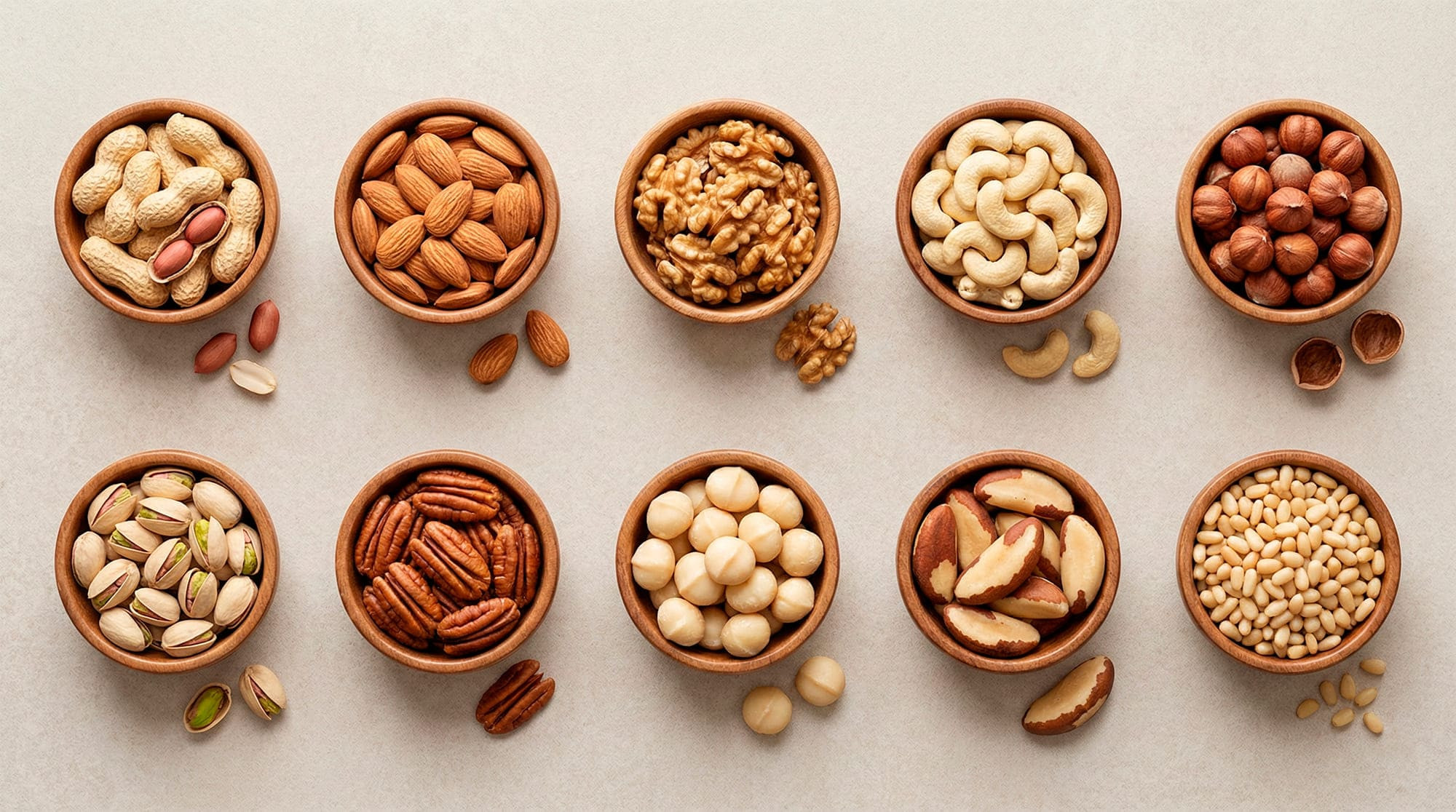
10 Most Popular Nuts Worldwide
Why nuts are so valued
Nutrient density: small volume, lots of energy
Nuts are all about “a few grams, a lot of impact.” A small handful can contain fats, protein, fiber, and minerals at the same time, and the calorie density is usually high. In practice, this means two things: nuts are great for “pulling together” a snack (especially when you need to hold out until a proper meal), but portions quietly grow — and with them, calories.
For everyday use, the simplest control is not to “eat straight from the bag,” but to portion it out right away. In a professional context (HoReCa/production), it also matters that nuts contribute not only flavor, but also the dish’s energy value: grams in a recipe can quickly change both food cost and the nutritional profile.
Nuts in cooking
The popularity of nuts isn’t driven only by “health benefits,” but by how functional they are in the kitchen.
- Texture: crunch, crumbs, paste, flour (breading, crumbles, fillings).
- Fats as a flavor carrier: nuts “hold” the aroma of spices, cocoa, salt, and acidity well.
- Sauces and emulsions: pastes, nut bases for sauces, drinks, dressings.
- Confectionery: marzipan, praline, fillings, creams, gluten-free baking.
For a buyer, this means: a “popular” nut is almost always one that sells confidently both as a snack and as an ingredient.
What makes a nut “popular” on the global market
Usually, several factors come together:
- Scale of production and supply stability (so the nut is present in mass retail and industry).
- Processability (easy to make spreads, flour, roast, and pack).
- Breadth of use (snack + cooking + confectionery + beverages).
- Price/availability (in this sense, peanuts are almost unmatched).
- Regulatory nuances (allergens, labeling, cross-contact in production).
Next, in the article I’ll break down each nut specifically through these practical criteria: where it’s used, why it’s mass-market, what the nutrition looks like, and which operational detail to keep in mind.
Peanuts
Where they’re used
Peanuts are a universal workhorse ingredient.
- Snacks: roasted, salted, in mixes.
- Spreads and oils: peanut butter, fillings, sauces.
- Cooking: Asian sauces and dressings (including those based on paste), crumbs for texture, marinades.
- Confectionery: praline, bars, caramel and chocolate products.
Why they’re so popular
The main paradox: peanuts are often called a nut, but botanically they are not a “true nut” — they are a legume, and the pods form underground. That’s exactly why peanuts historically became a mass product: they’re easier to scale as an agricultural crop, and processing (roasting, spreads) fits industrial production very well.
Another reason for their global popularity is the flavor profile: once roasted, peanuts deliver a rich “nutty” note and pair well with salt/sugar/cocoa, so they’re in equally high demand in snacks and in confectionery.
Nutritional value and calories
Per 100 g: 594 kcal, fat 49.2 g, protein 25.8 g, carbohydrates 7.6 g
Practical detail
Peanuts are one of the “major food allergens” in the US and belong to the group of foods that require mandatory allergen labeling. If you work in production/a professional kitchen, this affects storage, segregation of tools, and cross-contact management. Official reference on the list of major allergens: FDA — Food Allergies: What You Need to Know.
Interesting fact
Peanuts are a legume, with a specific agronomic trait: like other legumes, they are associated with nitrogen fixation and are often considered a crop that can improve soil in crop rotation systems.
Almonds
Where they’re used
Almonds are the king of “universal confectionery” and one of the key nuts for value-added products.
- Snacks and roasting: whole, sliced, chopped.
- Confectionery: marzipan, fillings, cookies, cakes, creams.
- Beverages and alternative products: almond drinks, pastes, flour.
- Cooking: sauces, coatings, salads, side dishes (slices/crumbs).
Why they’re so popular
Almonds are the seed of the Prunus dulcis tree, and they are globally stable thanks to large-scale industrial production and extremely broad use across the food industry. They are widely used raw, blanched, and roasted, and also as a base ingredient for baking and confectionery products.
For the market, format matters as well: almonds are easy to split into SKUs (whole/size grades/sliced/flour/paste), which makes them convenient for both retail and HoReCa/production.
Nutritional value and calories
Per 100 g: 601 kcal, fat 52.1 g, protein 21.2 g, carbohydrates 6.6 g.
Practical detail
In a professional kitchen, almonds often go through steps that significantly change how they behave in a dish:
- Blanching (removing the skin) — changes flavor and color, and simplifies texture for creams/spreads.
- Roasting — intensifies aroma, but requires control to avoid bitterness.
- Almond flour — affects water binding and dough structure (important for gluten-free and “low-carb” baking).
Interesting fact
California accounts for roughly 80% of the world’s almond supply, which makes almonds one of the rare truly “global” nuts with such a concentrated production geography. This concentration matters not only as a “where it grows” detail, but as a market mechanism: when most of the volume is concentrated in one region, weather, water constraints, labor availability, logistics, and even the pollination window there can noticeably affect global availability, lead times, and price dynamics.
Walnuts
Where they’re used
- Confectionery and baking: fillings, praline, sponge cakes, baklava.
- Sauces and spreads: nut sauces, spreads, pesto-style variations.
- Salads and cold appetizers: for texture and aroma.
- Hot dishes: with poultry, vegetables, grains (as a “rich crunch”).
Why they’re so popular
The main reason is recognizability and versatility: walnuts integrate easily into both sweet and savory applications, while delivering a pronounced aroma even at small dosages. From a procurement perspective, they’re convenient because there are many commercial formats: halves, quarters, pieces, paste — for different recipe specs and cost targets. Plus, demand is steady: this is one of those nuts that feels “familiar” both at home and in a professional kitchen.
Nutritional value and calories
Per 100 g: 680 kcal, fat 66.5 g, protein 14.1 g, carbohydrates 2.8 g.
Practical detail
Walnuts are high in unsaturated fats, so they go rancid faster than many other nuts if stored “warm and in the light.” For kitchens and production, a basic rule applies: keep them in a tightly sealed container, ideally in a cool place, and avoid buying “six months ahead” if turnover is irregular. In confectionery, the flavor often opens up better after light toasting, but it’s important not to overdo it: bitterness ramps up quickly.
Interesting fact
Botanically, the walnut is not a true “nut,” but a drupe-type fruit: the edible seed sits in a shell inside a fleshy outer husk.
Cashews
Where they’re used
- Snacks and nut mixes.
- Sauces and wok/curry dishes: both as a nut and as a base after grinding.
- Pastes and creams: fillings, desserts, “creamy” textures.
- Plant-based products: alternative “cream/cheese” (thanks to the creamy texture).
Why they’re so popular
Their popularity comes from a neutral, creamy taste and a “friendly” texture: cashews appeal to a wide audience and rarely clash with other ingredients. They sell consistently as whole kernels, halves, pieces, and paste — making it easy to choose a format for cost and use case (garnish / filling / sauce). Cashews are also often used as a “milder” alternative to more assertive nuts.
Nutritional value and calories
Per 100 g: 592 kcal, fat 43.9 g, protein 18.2 g, carbohydrates 29.4 g.
Practical detail
Cashews are almost always sold after processing, because the shell and resin around the kernel can be hazardous on contact; a safe product is obtained after heat treatment/roasting and shell removal. In procurement terms, this means “raw cashews” on a shelf are not “untreated straight from the tree,” but rather cashews that haven’t been roasted to develop a pronounced flavor (i.e., a milder-tasting product that still underwent safety processing).
Interesting fact
In traditional processing, cashew shells can release a caustic resin, and its fumes may irritate skin and eyes; modern roasting/processing methods are designed specifically to remove these toxic properties (Britannica — Cashew | Description, Poison, & Processing).
Hazelnuts
Where they’re used
- Chocolate and confectionery: praline, pastes, creams, fillings.
- Baking: cookies, muffins, sponge cakes, desserts.
- Chopped nuts/slices: toppings, garnish, crumbs for texture.
- Oils and pastes: as an aromatic fat base.
Why they’re so popular
Hazelnuts have a pronounced aroma that intensifies after roasting — so they deliver strong flavor even at low usage rates. For buyers, they’re a convenient nut: clear processing formats (whole, chopped, sliced, paste) and steady demand from confectioners. Hazelnuts are also often perceived as a “premium” ingredient — even without making a recipe more complex.
Nutritional value and calories
Per 100 g: 670 kcal, fat 65.0 g, protein 13.2 g, carbohydrates 3.3 g.
Practical detail
Hazelnuts are very sensitive to rancidity and to “foreign odors” (especially if stored near spices, coffee, etc.). In production, it can be cost-effective to buy raw nuts and roast to spec — it’s easier to control aroma and freshness that way. If a “cleaner” flavor is needed in creams, blanching/skin removal after roasting is often used to reduce potential bitterness.
Interesting fact
Commercial hazelnuts most often come from Eurasian species — the European hazel (European filbert, Corylus avellana) and the “giant” filbert (Corylus maxima), as well as their hybrids (Britannica — Hazelnut | Description, Species, & Facts).
Pistachios
Where they’re used
- Desserts and confectionery: ice cream, creams, fillings, sponge cakes, paste.
- Middle Eastern cuisine: sweets, rice and meat dishes, side dishes.
- Salads and appetizers: kernels/crumbs as an accent and texture.
- Snacks: roasted and/or salted formats.
Why they’re so popular
Pistachios stand out for both flavor and color: they’re instantly recognizable and visually make a dish feel more premium. As an ingredient, they scale well: you can use whole kernels for plating, or paste/crumbs for a cost-effective but consistent flavor. Because of their high added value, pistachios often serve as the “accent” that supports a higher price point on a menu.
Nutritional value and calories
Per 100 g: 589 kcal, fat 50.3 g, protein 21.6 g, carbohydrates 8.1 g.
Practical detail
A key point for kitchens is the difference between salted/roasted pistachios and raw ones: for desserts and creams, you typically need unsalted and often peeled (without the skin) to avoid affecting flavor and color. When buying paste, it’s important to check the ingredients: ideally it’s 100% nuts, or nuts with only minimal permissible additions (without extra sugar/oils), otherwise flavor and stability will vary significantly between batches.
Interesting fact
Pistachio is a plant in the cashew family (a relative of cashew) and is historically associated with the Iran region; today it’s grown in dry, warm areas from Central Asia to the Mediterranean and, for example, in California (Britannica — Pistachio | Description, Uses, & Nutrition).
Pecans
Where they’re used
- Baking and desserts: pies, muffins, caramel fillings
- Salads and bowls: as a “buttery” nut with mild sweetness
- Pastes and praline
Why they’re so popular
Pecans are especially strong where you need a “buttery” nut without sharp bitterness. In English-language culinary tradition, they’ve long been established as a dessert classic, and in B2B purchasing they’re often chosen as “more premium than walnuts” in terms of flavor profile.
Nutritional value and calories
Per 100 g: 737 kcal, fat 73.3 g, protein 8.8 g, carbohydrates 4.0 g.
Practical detail
Because of their very high fat content, pecans are prone to rancidity: batch freshness and storage conditions matter for turnover (cool, dry, airtight). In production, this is especially noticeable in praline and fillings, where rancidity comes through more strongly.
Interesting fact
Pecans are not a “walnut variant,” but a separate species in the hickory genus: Carya illinoinensis. Encyclopaedia Britannica.
Macadamia nuts
Where they’re used
- Premium snacks and gift mixes
- Confectionery: cookies, candies, white chocolate, caramel
- Macadamia oil: in sauces/dressings and in cosmetics (as an “oil” category product)
Why they’re so popular
Macadamias are perceived as premium: a very soft, “creamy” texture and high fat content create a recognizable flavor and the sense of an “expensive product.” In procurement, they are often used as an ingredient for high-margin items (desserts, gift ranges).
Nutritional value and calories
Per 100 g: 753 kcal, fat 75.8 g, protein 7.9 g, carbohydrates 5.6 g.
Practical detail
Because macadamias are expensive, in production it’s important to define the format in advance: whole kernels, halves, or pieces — these imply different cost scenarios and different losses during preparation (especially in baking and confectionery).
Interesting fact
Historically, macadamias are often “associated” with Hawai‘i, but the plant is originally Australian: the University of Hawai‘i (CTAHR) explicitly notes that macadamias were introduced to Hawai‘i from Australia (in the late 19th century). Macadamia Nuts in Hawaii: History and Production.
Brazil nuts
Where they’re used
- Nut mixes and granola
- Confectionery (in small dosages due to the pronounced flavor)
- “Functional” products (often because of their reputation for micronutrients)
Why they’re so popular
Brazil nuts are among the most “talked about” nuts in consumer circles because of their dense nutrition and pronounced flavor. For B2B, they’re also interesting because the product often works as an “accent” in mixes: 1–2 nuts provide a distinct character.
Nutritional value and calories
Per 100 g: 702 kcal, fat 67.8 g, protein 14.2 g, carbohydrates 1.8 g.
Practical detail
With Brazil nuts, it’s important not to turn “health benefits” into excess: they are known as one of the richest dietary sources of selenium, so in a diet a small portion usually makes sense — not “eaten like seeds.”
Interesting fact
Brazil nuts are the seeds of the Bertholletia excelsa tree, which grows in the Amazon — and that’s why this product differs significantly from most “plantation” nuts. A substantial share of the raw material is harvested in its natural range rather than grown on standard agricultural sites, so supply depends not only on demand and logistics, but also on the state of forest ecosystems and harvesting conditions in specific regions. This makes Brazil nuts a commodity where origin and supply-chain sustainability are closely linked: forest preservation, site accessibility, seasonality, and harvest organization directly affect volumes and supply stability.
Pine nuts
Where they’re used
- Sauces (including classic pesto), pastes, spreads
- Salads, hot dishes, and side dishes as an add-in
- Confectionery (less often, usually as a premium topping)
Why they’re so popular
Pine nuts deliver a unique “resinous-creamy” flavor that’s hard to replace with other nuts. At the same time, they’re often expensive due to the specifics of sourcing and harvesting, so in recipes they’re usually used as a targeted ingredient rather than a bulk component.
Nutritional value and calories
Per 100 g: 665 kcal, fat 61.9 g, protein 14.0 g, carbohydrates 9.9 g.
Practical detail
There is a rare but documented effect called “pine mouth” (a temporary change in taste perception with a metallic-bitter aftertaste), described in the medical literature as a reversible condition after consuming certain batches of pine nuts. PubMed — Pine mouth syndrome.
Interesting fact
Pine nuts are not “cedar nuts” in the everyday sense, but the seeds of certain pine species. So under one commercial name, different botanical raw materials may be sold: in different countries and from different suppliers, these may be different “pine nuts.” In practice, this is sometimes noticeable in flavor and cooking behavior: some batches give a softer, creamier profile, others a more resinous and intense one, and when toasted they can become bitter at different speeds. That’s why professional kitchens often aim to keep pine nuts from a consistent origin (one supplier/one specification), especially for pesto, sauces, or desserts where the nut’s flavor is a key element.
How to choose and store nuts so you don’t end up disappointed
Whole vs. chopped: what changes in freshness
The simplest rule: the smaller the particle size, the faster the flavor “drops off.” Chopped nuts have more surface area in contact with air, oxidize faster, and absorb foreign odors more easily. That’s why for home use and HoReCa it’s often more practical to keep a base stock as whole kernels and chop/grind only for a specific task and shift volume.
Another nuance: roasted nuts often give a stronger aroma immediately, but they lose quality faster in storage than raw nuts that you roast to order by batch.
How to recognize rancidity and why it happens
Rancidity isn’t “just age” — it’s fat chemistry.
How to recognize it:
- the smell becomes flat, “oily,” sometimes reminiscent of paint/cardboard;
- bitterness and an unpleasant aftertaste appear, even if the nuts look normal.
Why it happens:
- fats oxidize on contact with oxygen (heat and light accelerate this);
- at higher humidity, aroma degrades faster and a “damp” note appears.
Moisture, heat, and light: three enemies of flavor
If you reduce storage to three manageable risks, they are:
- oxygen (the main accelerator of oxidation),
- light (accelerates deterioration of fats and aromas),
- heat and humidity (speed up both oxidation and “staleness”).
A practical setup for business: keep the main batch cool and dark in airtight packaging, and at the workstation keep only the “operational volume” for the day/shift. Technical materials on nut quality explicitly emphasize the importance of storing in the dark and protecting from oxygen; otherwise browning develops faster and a rancid smell/taste appears: Quality of peanuts, walnuts, pistachio's and raisins (Wageningen UR report).
Packaging and shelf life
On nut packaging, you’ll most often see “best before” rather than “use by”: it’s about optimal flavor, not immediate danger after the date. What’s actually useful to check:
- Packaging type: opaque or foil-lined is better, with a good oxygen barrier.
- Seal integrity: a zip-lock is fine for home use, but for professional storage, containers with a tight lid and minimal headspace are better.
- Smell on opening: if there’s already an “oily” mustiness at the start, the batch is risky even if the date looks fine.
How much is reasonable: portion size and allergy caution
Portion size for snacking and for cooking
As a practical reference, it helps to keep ~30 g of nuts in mind as “one serving” (essentially a small handful). This isn’t a strict rule, but a workable scale that helps avoid overeating and overloading a dish with calories. As a reference point for portions and examples of converting to pieces, you can use: Better Health Channel — Nuts and seeds.
How to apply it in practice:
- snacking: 1 serving, preferably pre-portioned;
- cooking: start with a small percentage in the recipe and adjust to taste, because nuts quickly “pull” a dish’s profile and food cost upward.
Allergy: where reactions are most common
In food-industry practice, the most “frequently problematic” nuts are those that are most common in circulation and recipes: walnuts, almonds, hazelnuts, pecans, cashews, pistachios (as the most widespread tree nuts). This is worth remembering not only for labeling, but also for cross-contact in kitchens and production. Summary of the most common allergens among tree nuts: Food Allergy Research & Education — Tree Nut Allergy.
Key takeaway
Popular nuts are valued not for “health benefits in a vacuum,” but for the combination of flavor, texture, and high nutrient density. This is an ingredient that quickly makes a dish feel “more expensive”: it adds aroma, richness, crunch, or creaminess. But that’s exactly why nuts work best as an accent rather than a base: a small addition often delivers the same flavor impact as a large one, without excessive calories and without driving up food cost. This is especially noticeable in sweet applications: nuts can easily overload a recipe and start “pulling” the flavor toward themselves.
If you approach it pragmatically, there are three working rules for nuts. First is portioning and dosage: for snacking and cooking, it’s easier to stay in control with a pre-measured handful or grams in a recipe spec. Second is format: whole kernels usually retain flavor and aroma longer, and chopping/crumbs are best done closer to use to avoid losing freshness. Third is storage as flavor protection: nuts don’t spoil “suddenly,” but through fat oxidation, so air, light, and heat/moisture are the key enemies. When these are managed, nuts stop being a “lottery” and become a consistent ingredient — at home, in HoReCa, and in production.
Latest blog posts
-
Top 10 Supermarket Chains in Austria: A Brief Overview
Austria’s grocery retail market brings together national chains, international groups, discounter...
-
Top 10 Supermarket Chains in Belgium: A Brief Overview
Belgium’s grocery retail sector brings together national chains, international groups, discounter...
-
Olive Oil Producers in Spain for B2B Sourcing
Spain's olive oil sector combines cooperative mills, industrial processors, refiners, bottlers, a...
-
Top 10 Largest Grocery Chains in Italy
Italy’s grocery market is divided among cooperative groups, national supermarket brands, internat...
-
Top 10 Largest Grocery Chains in Sweden: A Brief Overview
An overview of Sweden's largest grocery retail chains, including store formats, geographic covera...


Categories
- Reviews of products and manufacturers
- Allfoods Market System Features
- Market Insights
- Food Technologies
Latest posts in partners' blogs
-
Uzbekistan Food Exports and Key Markets
Uzbekistan’s food exports are expanding well beyond fresh produce. Fruit, vegetables, flour, mung...
-
Kazakhstan Food and Agricultural Exports
Kazakhstan’s export offer extends well beyond wheat and other grains. International buyers can al...
-
Alpine Beef Ribeye: The Pinnacle of Flavor and Excellence for Your HoReCa and Retail Business
The Perfect Steak Starts with a Name: Alpine
-
Uganda Agricultural Exports and Key Products for B2B Sourcing
Uganda’s agricultural export profile is dominated by coffee, but the commercial picture is broade...
-
Food Exports from Morocco
Morocco’s food export profile extends well beyond citrus and olive oil. Fresh tomatoes, berries, ...