

 Español
 Русский
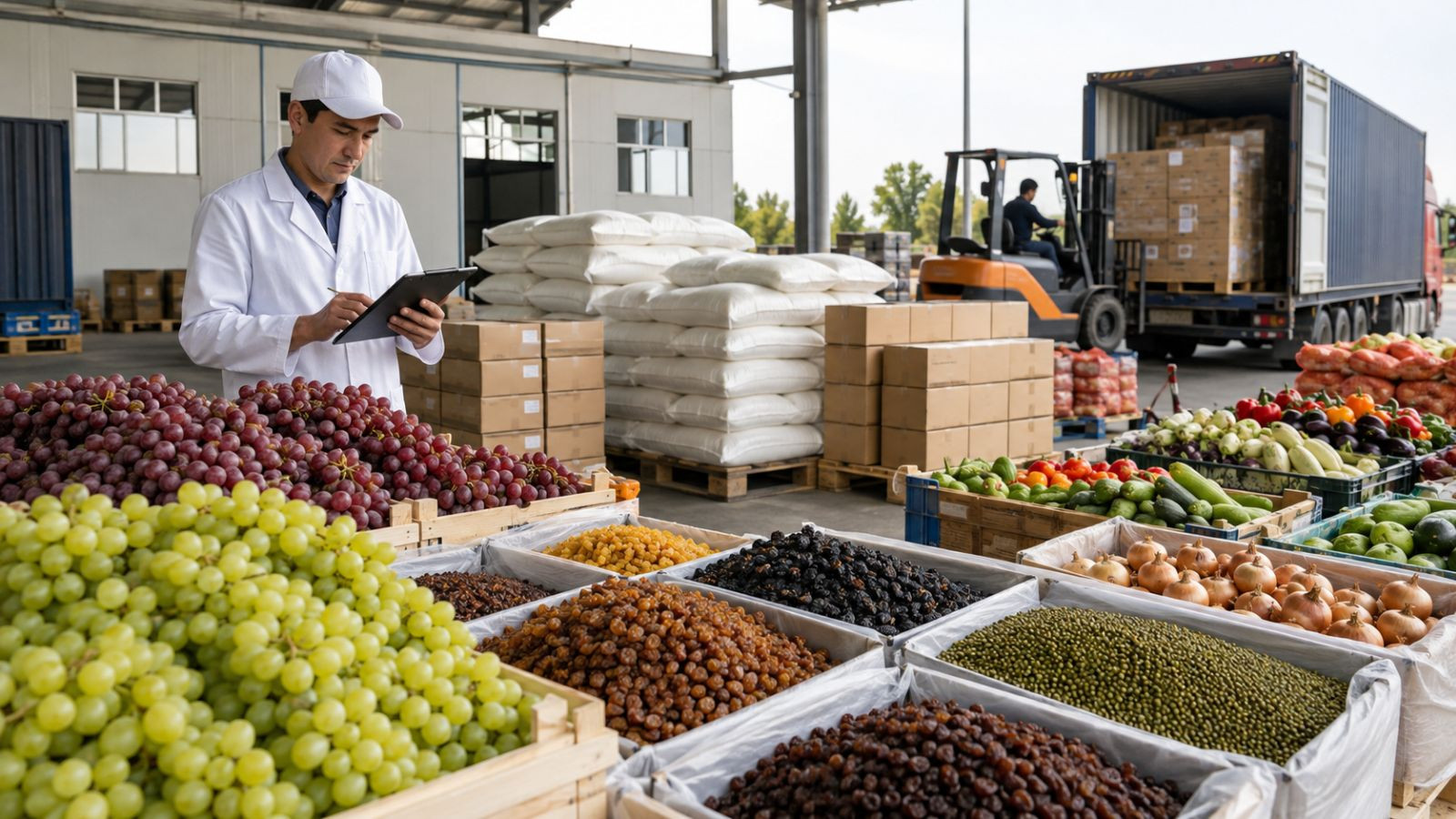
Uzbekistan Food Exports and Key Markets
Uzbekistan is strengthening its position in the regional food market. In 2025, exports of food and live animals under the SITC classification reached $2.94 billion, up 35.4% year over year. The country's main export categories include fruit, vegetables, dried fruit, flour, pulses, and processed fruit and vegetable products.
Uzbekistan's export model, however, varies considerably by product. Fresh fruit and vegetables are largely shipped to Russia and neighboring countries, flour exports are almost entirely destined for Afghanistan, while China has become one of the main buyers of Uzbek mung beans. For importers, this makes it important to evaluate not only the product itself, but also the destination market, seasonality, and transport route.
At a glance
- exports of food and live animals reached approximately $2.94 billion in 2025, up 35.4% from the previous year;
- fruit and nut exports reached $1.07 billion, while vegetables and root crops approached $976 million;
- approximately 2.16 million metric tons of fruit and vegetable products were exported, with a total value of $2.12 billion;
- wheat flour exports totaled approximately 1.6 million metric tons, valued at $441.7 million;
- the country's lack of direct access to the sea makes transport costs and the reliability of overland routes particularly important for buyers.
Export figures
| Category | Exports in 2025 | Change from 2024 |
| Fruit and nuts | $1.071 billion | +35.6% |
| Vegetables and root crops | $976 million | +40.6% |
| Milling industry products | $442 million | +34.1% |
| Processed vegetables, fruit, and nuts | $138 million | +50.2% |
| Grain- and flour-based products | $70 million | +88.2% |
| Dairy products, eggs, and honey | $63 million | +34.4% |
| Fats and oils | $61 million | +23.2% |
The figures by product group are based on Uzbekistan's foreign trade statistics. When comparing them, it is important to account for differences between international classification systems: figures for individual product groups cannot simply be added to the overall food export figure.
Main export products
Fruit and dried fruit
Fruit and nuts remain Uzbekistan's largest food export category. In 2025, exports of fresh grapes were valued at approximately $245 million, raisins at $144 million, peaches at $105 million, and sweet cherries at approximately $72 million.
Fresh produce is particularly dependent on proximity to the destination market and speed of delivery. As a result, a significant share of grapes, stone fruit, and other perishable fruit is shipped to Russia and neighboring countries. Dried fruit can be transported over much greater distances, broadening the range of potential markets. AllFoods Market also has a dedicated category for raisins, one of Uzbekistan's most significant dried fruit exports.
Vegetables
Exports of vegetables and root crops approached $1 billion in 2025. Significant products include onions, cabbage, tomatoes, peppers, carrots, and other fresh vegetables.
For high-volume products with a relatively low value per metric ton, transport costs are particularly important. The competitiveness of Uzbek vegetables therefore depends heavily on the distance to the buyer, border clearance times, and the cost of road or rail transport.
Wheat flour
Flour occupies a distinct position in Uzbekistan's food exports. In 2025, the country exported approximately 1.6 million metric tons of wheat flour valued at $441.7 million. Offers from producers and sellers of these products are available in the flour category on AllFoods Market.
Almost the entire export volume was shipped to Afghanistan. This concentration makes the segment both substantial and highly dependent on a single market. At the same time, Uzbekistan imports significant volumes of grain and flour itself, primarily from Kazakhstan, meaning that the export model of its milling industry is closely connected to regional grain trade.
Mung beans
Mung beans have also become a significant export product. In 2025, shipments reached approximately 148,000 metric tons, valued at around $149 million.
China is one of the main buyers of Uzbek mung beans. Procurement and storage requirements for this category differ from those applied to fresh fruit and vegetables. For importers, key parameters include lot origin, uniformity, moisture content, purity, grading, and laboratory results.
Processed fruit and vegetables
Exports of processed vegetables, fruit, and nuts increased by approximately 50% in 2025, reaching $138 million.
In value terms, this category remains substantially smaller than fresh produce, but its importance is gradually increasing. Dried, canned, and other processed products have a longer shelf life and are less dependent on seasonal constraints and temperature-controlled transport.
Key markets
Uzbekistan's food exports are not concentrated in a single market.
Russia remains one of the most important destinations for fresh grapes, tomatoes, stone fruit, and other perishable products. Kazakhstan serves both as a buyer and as an important transit country for shipments moving north.
Afghanistan largely defines the export geography of wheat flour. China plays a particularly significant role in purchases of mung beans and certain types of dried fruit.
Dried products generally have a broader export geography than fresh produce. Raisins and other dried fruit are shipped not only to CIS countries, but also to Turkey, China, Middle Eastern markets, and other regions.
For buyers, this means Uzbekistan's export potential should be assessed separately for each product. Demand patterns, distance to market, and transport requirements can differ substantially.
Logistics
Uzbekistan has no coastline and is one of the few countries in the world from which reaching a seaport requires crossing the territory of at least two other countries. As a result, most food exports depend on road and rail routes through neighboring states.
Overland corridors through Kazakhstan are particularly important for shipments to Russia and Kazakhstan. Trade with China also relies on land routes across Central Asia. More distant markets are reached through combinations of rail, road, and sea transport via the Caspian region, the Caucasus, or southern routes.
For fresh fruit and vegetables, border clearance speed, pre-cooling, refrigeration equipment reliability, and maintaining the required temperature throughout transit are critical. By fall 2025, total cold-storage capacity in the country exceeded 1.1 million metric tons, although buyers still need to assess the capabilities of the individual supplier for each specific purchase.
What wholesale buyers should consider
Supplier due diligence should begin with establishing the company's actual role in the supply chain. A company may be a producer, processor, owner of a packing facility, or a trading company sourcing products from several farms.
For each lot, the parties should agree in advance on product origin, quality specifications, harvest or production date, packaging, labeling, laboratory parameters, and acceptance conditions.
Documentation requirements depend on the product and destination country. Plant products may require phytosanitary documentation, while products of animal origin are subject to veterinary requirements. In recent years, Uzbekistan has also strengthened controls over the origin of plant products intended for export.
When purchasing perishable goods, buyers and sellers should separately agree on the loading location, lot preparation time, temperature requirements, expected transit time, and allocation of costs and risks between the parties.
Where to find suppliers
Uzbekistan is of particular interest as a source of fresh and dried fruit, vegetables, flour, pulses, and a gradually expanding range of processed products.
When selecting a supplier, buyers should compare not only price, but also product origin, production capacity, consistency of available volumes, packaging, documentation, and the company's ability to meet the requirements of the destination market.
Wheat flour, raisins, fresh grapes, mung beans, dried fruit, and processed fruit and vegetable products warrant separate evaluation. Each of these categories has its own export geography, seasonality, and structure of international demand.
Frequently asked questions
What are Uzbekistan's largest food exports?
The largest food export categories include fruit and nuts, vegetables, milling industry products, and processed fruit and vegetable products. Major individual products include fresh grapes, raisins, wheat flour, mung beans, peaches, and onions.
How much food did Uzbekistan export in 2025?
Exports in the SITC category "food and live animals" totaled approximately $2.94 billion. This figure does not represent the country's entire agricultural export volume because certain types of products are recorded under other sections of trade statistics.
Which countries are the main buyers?
Russia is particularly important for fresh fruit and vegetables, Afghanistan for wheat flour, and China for mung beans. Kazakhstan serves both as an export market and as an important transit route.
What is the main logistical consideration when importing from Uzbekistan?
The main factor is the lack of direct access to the sea. Most cargo travels through neighboring countries, so delivery times and costs are affected by the condition of overland routes, border clearance, and the need to maintain temperature control for perishable products.
Sources and data
- National Statistics Committee of the Republic of Uzbekistan, foreign trade data for 2025
- SIAT information system, Uzbekistan exports by product group
- National Statistics Committee of the Republic of Uzbekistan, data on fruit and vegetable exports
- World Bank, materials on Uzbekistan's transport connectivity and trade costs
- Agency for Plant Quarantine and Protection under the Ministry of Agriculture of the Republic of Uzbekistan
- Committee for Veterinary Medicine and Livestock Development of the Republic of Uzbekistan
AllFoods Market: Latest Blog Posts
-
Top 10 Supermarket Chains in Austria: A Brief Overview
Austria’s grocery retail market brings together national chains, international groups, discounter...
-
Top 10 Supermarket Chains in Belgium: A Brief Overview
Belgium’s grocery retail sector brings together national chains, international groups, discounter...
-
Olive Oil Producers in Spain for B2B Sourcing
Spain's olive oil sector combines cooperative mills, industrial processors, refiners, bottlers, a...
-
Top 10 Largest Grocery Chains in Italy
Italy’s grocery market is divided among cooperative groups, national supermarket brands, internat...
-
Top 10 Largest Grocery Chains in Sweden: A Brief Overview
An overview of Sweden's largest grocery retail chains, including store formats, geographic covera...