

 Español
 Русский
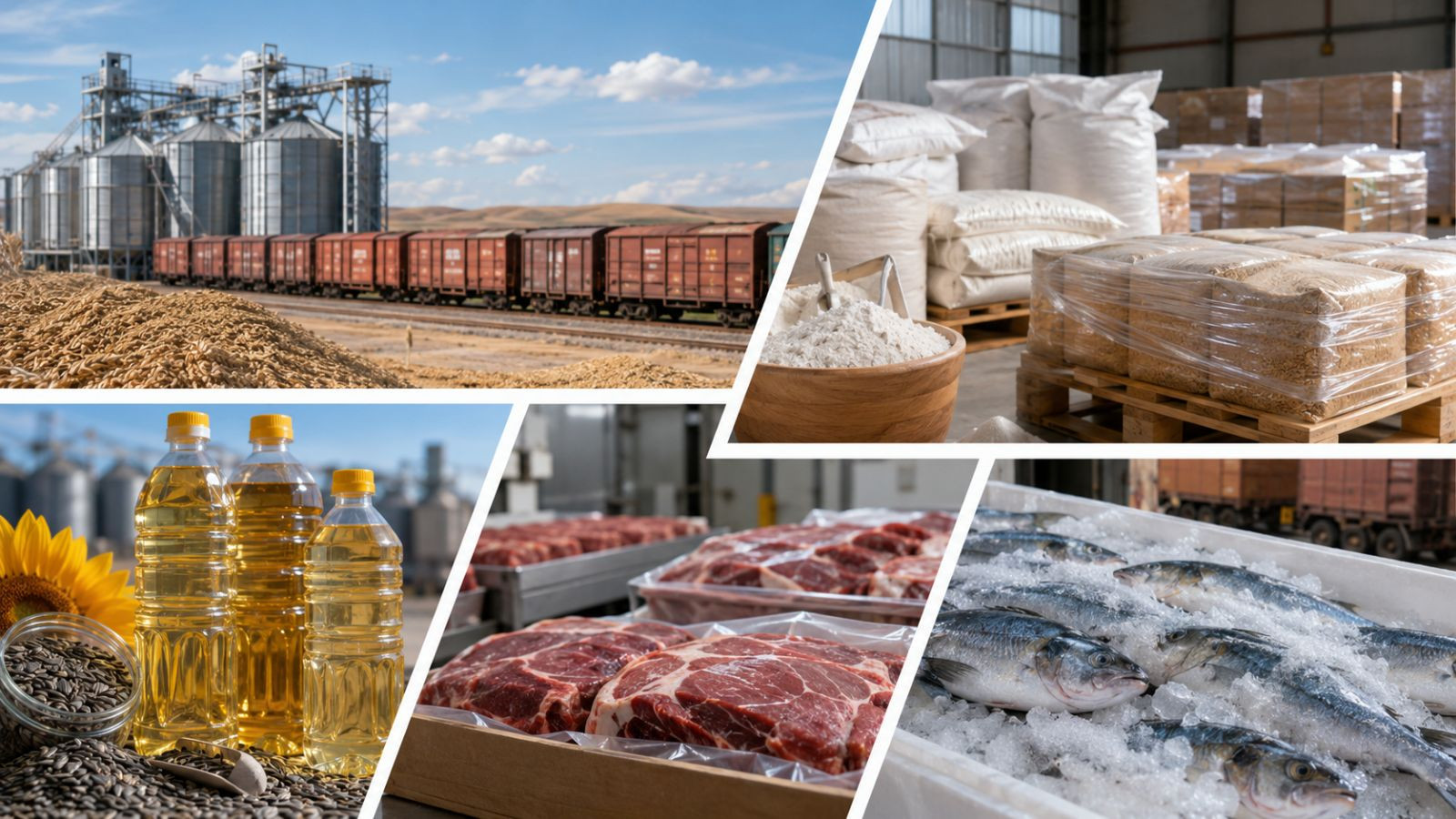
Kazakhstan Food and Agricultural Exports
Kazakhstan remains a major grain exporter, but the country's export portfolio is considerably broader. In addition to wheat and other agricultural crops, Kazakhstan exports flour, vegetable oils, processed oilseed products, meat, fish, and other food products. In 2025, agricultural and food exports reached $7 billion, with processed products accounting for $3.6 billion. Wheat and flour still represent a significant share of trade, but oilseeds and vegetable oils and fats are growing more rapidly. For B2B buyers, Kazakhstan offers a combination of large-scale commodity flows and a developing food processing industry.
Key Facts
- Agricultural and food exports reached $7 billion in 2025, up 37% year over year.
- Processed products generated $3.6 billion and accounted for 51.4% of the sector's export revenue.
- The grain harvest reached 25.9 million metric tons, including 19.3 million metric tons of wheat.
- Export revenue from the oils and fats sector reached $963 million, approximately four times the 2021 level.
- Central Asia remains the core market for grain and flour, while China is rapidly increasing purchases of oils, oilseeds, and feed products.
Exports in Figures
| Category | Latest Reliable Benchmark | Trend |
| Agricultural and food products | $7 billion, 2025 | +37% |
| Processed products | $3.6 billion, 2025 | +35% |
| Wheat HS 1001 | $1.12 billion and 5.91 million metric tons, 2024 | strong growth in 2025 |
| Wheat flour | 1.93 million metric tons, 2025 | close to the 2023 level |
| Oils and fats | $963 million, 2025 | approximately 4 times the 2021 level |
| Beef and lamb | 32.3 and 34.5 thousand metric tons, 2025 | 1.5-fold and 1.9-fold growth |
| Fish products | 21 thousand metric tons, 2025 | exports to 21 countries |
For individual products, 2024 trade values and physical volumes are based on WITS / UN Comtrade data, as this source allows trade flows to be compared at the individual HS-code level.
Main Export Products
Wheat and Grain
Wheat remains the leading export product in Kazakhstan's agricultural and food sector and underpins the country's large rail freight flows. In 2024, Kazakhstan exported 5.91 million metric tons of wheat and meslin worth $1.12 billion. The main buyers were Uzbekistan, Tajikistan, China, Italy, and Afghanistan. Trade volumes increased significantly in 2025. For buyers, the quality of the specific shipment, crop year, dispatch station, and availability of railcars are particularly important.
Flour
Kazakhstan remains a major supplier of wheat flour, although this segment is developing more slowly than grain trade. In 2025, the country exported 1.928 million metric tons, compared with 1.959 million metric tons in 2023. Around 98% of the volume is shipped to Central Asia and Afghanistan. At the same time, Afghanistan's share has declined, while Uzbekistan is expanding domestic processing of imported wheat. This represents an important structural shift for Kazakhstan's milling industry.
Oilseeds and Vegetable Oils
This is one of Kazakhstan's fastest-growing export segments. The oilseed harvest reached 4.8 million metric tons in 2025, while vegetable oil production increased to 888.8 thousand metric tons. Export revenue from the oils and fats sector reached $963 million. Key markets include China, Uzbekistan, Tajikistan, Afghanistan, and European countries. In addition to sunflower oil, flaxseed, rapeseed, sunflower seeds, and processed oilseed products are important export categories in their own right.
Barley, Flaxseed, and Other Crops
In 2024, Kazakhstan exported approximately 1.6 million metric tons of barley worth $265 million, primarily to China and Iran. Flaxseed exports reached 424 thousand metric tons valued at $212 million, with China and Belgium among the largest buyers. At the same time, the country is increasing pulse production. These categories are smaller than wheat in scale but make Kazakhstan's export structure considerably more diversified.
Meat and Fish
Meat and fish exports remain significantly smaller than grain exports, but both segments are becoming more prominent. In 2025, exports of beef reached 32.3 thousand metric tons, while lamb exports reached 34.5 thousand metric tons. Fish exports totaled 21 thousand metric tons, and 20 Kazakhstani processors are authorized to supply products to the EU. For these categories, veterinary approval of the processing facility, cold-chain integrity, and destination-market requirements are particularly important. AllFoods Market also features a dedicated frozen fish category.
Main Export Markets
Kazakhstan's export geography varies considerably by product category. Uzbekistan, Tajikistan, Kyrgyzstan, and Afghanistan are particularly important markets for wheat, flour, and other grain products. China purchases a broader range of goods: in 2025, Kazakhstan's agricultural and food exports to China reached $1.43 billion, with feed products, vegetable oils, flaxseed, sunflower products, and rapeseed oil among the main categories.
Iran is an important market for certain grains, while EU countries are significant destinations for flaxseed, selected oils and fats products, and fish products. This geographic distribution shows that Kazakhstan's export model is no longer limited to a single grain-oriented trade route.
Logistics
Kazakhstan has no direct access to the world's oceans, so the competitiveness of its exports depends heavily on rail transport and transit corridors. Southern routes serve Central Asian markets. Cargo bound for China moves through Dostyk-Alashankou and Altynkol-Khorgos. The Caspian route uses the ports of Aktau and Kuryk, followed by transshipment.
In 2025, Kazakhstan Temir Zholy, or KTZ, shipped 11 million metric tons of grain for export. At the same time, rail shipments to Central Asia, Azerbaijan, Iran, and Afghanistan increased. For importers, this means that the price at the grain elevator or processing plant does not provide a complete picture of landed cost. Rail transport, transit, transshipment, and seasonal infrastructure congestion must all be assessed separately.
What B2B Buyers Should Consider
Supplier verification should begin with the legal entity and its actual production, processing, or storage facilities. Contracts should clearly specify the origin and specifications of the shipment, quality-control methods, packaging, dispatch point, Incoterms, and acceptance procedures.
Documentation requirements depend on the product category and destination market. Plant products may require phytosanitary documents, while meat, dairy, and fish products may require veterinary certificates and approval of the establishment. Before signing a contract, buyers should also verify any current export restrictions and the requirements of the destination country.
Where to Find Suppliers
The Kazakhstan country page on AllFoods Market features local producers and products across multiple categories. For a more detailed market assessment, buyers can move from this general overview to individual product segments.
Wheat, sunflower oil, flaxseed, flour, barley, meat, and fish products from Kazakhstan are among the categories that warrant more detailed analysis.
FAQ
What food and agricultural products does Kazakhstan export?
The main categories include wheat and other grains, flour, oilseeds, vegetable oils, and processed oilseed products. Exports of beef, lamb, fish products, and selected pulses are also increasing.
Where does Kazakhstan export food and agricultural products?
Central Asia and Afghanistan are especially important for grain and flour, China for oils, oilseeds, and feed products, Iran for certain grains, and the EU for selected oilseed products and fish products.
What is the main logistics factor when sourcing from Kazakhstan?
The key factor is the country's reliance on rail and transit routes. Delivery costs and lead times can vary depending on railcar availability, border-crossing capacity, port transshipment, and seasonal pressure on transport infrastructure.
What documents are required to import products from Kazakhstan?
There is no single standard document package. Requirements depend on the product and destination country. Buyers should verify commercial and customs documentation, origin, labeling, and, where applicable, phytosanitary or veterinary certificates and establishment approvals.
Sources and Data
- Bureau of National Statistics of the Republic of Kazakhstan, foreign trade statistics.
- Ministry of Agriculture of the Republic of Kazakhstan, agricultural sector development and export results.
- WITS / UN Comtrade, Kazakhstan foreign trade by commodity code.
- Committee for State Inspection in the Agro-Industrial Complex of the Republic of Kazakhstan.
- Committee for Veterinary Control and Supervision of the Republic of Kazakhstan.
- KTZ, data on rail transportation of grain.
- Fisheries Committee of the Republic of Kazakhstan.
AllFoods Market: Latest Blog Posts
-
Top 10 Supermarket Chains in Austria: A Brief Overview
Austria’s grocery retail market brings together national chains, international groups, discounter...
-
Top 10 Supermarket Chains in Belgium: A Brief Overview
Belgium’s grocery retail sector brings together national chains, international groups, discounter...
-
Olive Oil Producers in Spain for B2B Sourcing
Spain's olive oil sector combines cooperative mills, industrial processors, refiners, bottlers, a...
-
Top 10 Largest Grocery Chains in Italy
Italy’s grocery market is divided among cooperative groups, national supermarket brands, internat...
-
Top 10 Largest Grocery Chains in Sweden: A Brief Overview
An overview of Sweden's largest grocery retail chains, including store formats, geographic covera...