

 Español
 Русский
The Anatomy of Trust in International Trade
Table of Contents
- How Importers Choose Suppliers Today
- The Importer's Real Decision-Making Journey
- Why Risk Trumps Price: The Economics of Importer Purchasing Decisions
- Why Buyers Stop Responding
- How Trust is Formed
- Practical Exporter Checklist: Audit of Readiness for International B2B Sales
- Why Trust Becomes a Competitive Advantage: The Macroeconomics of Commercial Preferences
- The Future of Trust in International Trade: Shifting to Algorithmic Ecosystems
- About the AllFoods Market Platform
How Importers Choose Suppliers Today
The Anonymous Research Paradigm: The New Reality for Procurement Committees
The contemporary global retail and wholesale food market is undergoing a seismic shift. The legacy model, where export sales were driven by cold calling, participation in international trade fairs, and interpersonal negotiation skills, has been supplanted by an era of strict digital compliance. According to the Gartner B2B Buying Journey Report, 2024, modern B2B buyers spend only about 17% of their total procurement cycle on direct meetings and negotiations with potential suppliers. When the candidate pool comprises multiple international companies, any single vendor receives no more than 5–6% of the buyer's total procurement timeframe.
What transpires during the remaining 83% of the timeline? It is dedicated to a process analysts define as supplier due diligence. Large-scale international importers, distributors, or retail chain representatives shape their procurement decisions long before an exporter's manager receives the initial email or phone call. According to the 6sense Buyer Experience Report 2025, 95% of buyers establish their supplier shortlist prior to making first contact, and in 77% of instances, the deal is secured by the initial frontrunner. The importer identifies a supplier, evaluates their digital corporate assets within a matter of minutes, and makes a strategic choice: invest organizational resources in a dialogue or permanently abandon the vendor.
This hidden elimination process is anchored in risk assessment. Amid elevated supply chain volatility, rigorous sanitary mandates, and cross-border trade barriers, corporate trust has transitioned into a quantifiable economic asset. If a supplier fails to deliver a sufficient volume of verifiable information during the initial analysis phase, they are silently dropped from the selection process. Understanding the actual journey a procurement committee undergoes when auditing a counterparty enables exporters to re-engineer their digital infrastructure and mitigate the loss of high-conversion leads.
Components of Supplier Due Diligence: Through the Lens of the Importer's Eight Filters
The verification of a new foreign counterparty is a highly structured, systematic procedure consisting of eight sequential filters. Each operates as a barrier designed to screen out high-risk or underprepared partners.
1. Global Search Footprint in Google and Artificial Intelligence Ecosystems
At the foundational stage, the importer evaluates the vendor's presence within the global information landscape. Procurement committees analyze not only direct brand mentions but also the broader context in which the manufacturer is referenced. In recent years, this evaluation has increased in complexity due to the widespread adoption of large language models. According to the previously cited 6sense Buyer Experience Report 2025, 94% of B2B buyers utilize large language models (LLMs) during the research phase, including supplier comparisons and review analysis.
When a brand is absent from search engine indices or lacks mentions in analytical industry overviews, AI algorithms and procurement specialists cannot validate its operational existence. International traders cannot jeopardize corporate liquidity by engaging with business entities that lack an established digital history. Consequently, a low search footprint triggers automatic exclusion from the longlist. Conversely, systematic efforts toward data transparency and inclusion in authoritative industry registries ensure a company comes onto the importer's radar at the inception of demand.
2. The Corporate Website as a Reflection of Operational Maturity
A manufacturer's official website serves as the primary instrument for deep due diligence. Importers scrutinize it not as a simple product catalog, but as a critical source of intelligence regarding production capabilities. A professional buyer seeks precise technical specifications, logistics maps, temperature storage parameters, packaging standards, and production capacity metrics.
If a company's website is merely a superficial brochure website populated with generic statements about quality, it instills deep skepticism regarding the scale of the enterprise. International trade demands standardization. The absence of comprehensive technical documentation in English or the target market's language signals that the manufacturer is focused exclusively on domestic markets and is unequipped for the stringent protocols of export operations. Consequently, the evaluation is terminated within 2–3 minutes.
Conversely, a mature B2B portal featuring open technical documentation eliminates fundamental buyer apprehensions and allows them to verify technological compatibility.
3. Human Capital Verification via LinkedIn
Auditing employee and executive profiles on the professional network LinkedIn is a mandatory element of contemporary regulatory compliance. Importers cross-reference claims displayed on corporate websites with the actual human capital of the enterprise. They evaluate the profiles of commercial directors, heads of export operations, food technologists, and chief executives.
International trade has seen a surge in encounters with fictitious brokers and fraudulent shell structures. If an enterprise lacks a verified company page on LinkedIn, and the profiles of its key executives are absent or neglected, the importer assumes a high risk of encountering unauthorized agents. This level of team anonymity erodes trust. Establishing comprehensive, active corporate accounts with verified employment histories functions as a digital guarantee of legitimacy. It demonstrates to the importer that they are evaluating an authentic business with an established organizational matrix.
4. External Independent Reviews and Claims
Importers systematically disregard testimonials hosted on a supplier's own resources, turning instead to independent industry forums, public arbitration court records, and specialized B2B trade networks. They seek evidence of commercial disputes, litigation history, or recurrent supply disruptions.
Any unmitigated negative feedback or indications of contractual breaches can immediately halt a procurement cycle. In the Food & Beverage sector, where margins are frequently compressed to single digits, the financial consequence of partnering with a problematic supplier can completely erode a distributor's annual profitability. If unresolved quality complaints are recorded within the digital space, the contract will not proceed to signing. The mitigation here lies in proactive reputation management across neutral international trade platforms where reviews are moderated and authenticated based on historical transactions.
5. International Certification as a Non-Negotiable Market Access Threshold
The availability of valid, high-resolution certificates (such as HACCP, ISO 22000, BRC, IFS, or FSSC 22000), alongside proof of regulatory registration in the target jurisdiction, is verified by the procurement committee before logistics calculations even commence. The committee evaluates document validity periods and their specific scopes of accreditation.
Regulatory compliance standards vary considerably by jurisdiction. Within the EU, products of animal origin require veterinary certification processed via the TRACES network and mandatory clearing through designated Border Control Posts (BCPs). The US mandates facility registration with the FDA and compliance with the FSVP (Foreign Supplier Verification Program). The EAEU applies strict veterinary and phytosanitary certifications validated through regional regulatory registries.
For numerous categories of plant-based products or confectionery goods, mandatory third-party certifications are not required—a sanitary certificate from the exporting country and compliance with EU Regulations (EC) No 852/2004 and (EC) No 178/2002 are sufficient. If a manufacturer asserts compliance with these criteria but fails to make verifiable copies of documentation publicly available, the buyer will rarely spend time issuing clarification requests. Clear placement of current regulatory documentation within the company's digital profile circumvents this barrier, establishing the safety and consistency of production cycles.
6. Direct Endorsements from Chambers of Commerce and Trade Associations
Enterprise-scale buyers frequently cross-check a supplier's operational standing with national Chambers of Commerce, ministries of agriculture, or specialized export associations. The inclusion of a vendor within official national exporter registries serves as a powerful validation of reliability.
Information asymmetry between distinct geographic markets compels importers to look for authoritative third-party guarantors. Lacking institutional validation from recognized associations, a supplier is perceived as an isolated entity with unpredictable market behavior. Absence from trusted partner directories inflates the perceived operational risk. Official membership in accredited associations and the availability of recommendation letters from state departments mitigate this concern, acting as an independent validation of fiscal and operational compliance.
7. Historical Export Track Record and Customs Database Analysis
Professional importers leverage data analytics tools (such as ImportGenius, Panjiva, or Datamyne) to verify a supplier's genuine transactional volume. They monitor precise metrics regarding shipment volumes, HS codes, target export regions, and historic counterparty identities recorded over recent fiscal years.
An export track record cannot be simulated via marketing collateral. If corporate claims of "global recognition" are contradicted by blank records within customs databases, the importer detects a critical integrity discrepancy. To the buyer, this implies that their enterprise will become an unproven testing environment for an inexperienced export department. The probability of administrative errors in export declarations and phytosanitary certificates increases exponentially. Conversely, a documented, consistent record of cross-border shipments within customs registries assures the importer that the vendor possesses mature, functional protocols for interfacing with logistics operators and border authorities.
8. Comprehensive End-to-End Corporate Digital Footprint
The final filter involves evaluating the cohesive integrity of the supplier's entire digital ecosystem. This encompasses active participation in international electronic tenders, presence on specialized B2B trade platforms, editorial features in industry media, and entries in digital directories.
If an enterprise maintains a high-quality website but lacks any broader digital footprint across the web, this raises red flags, raising suspicions that a synthetic facade has been engineered for a one-off transaction. In contemporary commerce, trust is distributed across multiple external channels. A robust, organic digital footprint on independent B2B platforms substantiates a brand's long-term market commitments. This reassures the importer of the partner's structural permanence and data transparency.
The Importer's Real Decision-Making Journey

The matrix below outlines the systematic progression of an importer through the trust funnel prior to executing an initial call or distributing a Request for Quotation (RFQ). It highlights precisely where and why unaligned exporters are excluded from consideration.
| Stage of the Importer's Journey | Verification Channel and Tool | Key Risk Indicator for the Buyer | Operational Consequence of the Verification |
| 1. Initial Screening | Search engines, LLM models, global industry directories | Complete absence of brand mentions or an outdated digital footprint | Exclusion of the supplier from the longlist without notification |
| 2. Infrastructure Audit | Official company website, B2B profiles | Absence of detailed English specifications, logistics parameters, and HS codes | Rejection of the lead due to suspected immaturity of export processes |
| 3. Regulatory Compliance | Government registries, certification center databases | Absence of valid international certifications (HACCP, ISO, BRC) or proof of registration in the target market | Halting of the evaluation due to the impossibility of legal customs clearance |
| 4. Structural Verification | Corporate profiles and employee pages on LinkedIn | Anonymity of management, absence of real profiles for the export team | Suspicion of fraud, operating through unauthorized intermediaries, or shell companies |
| 5. Trade History Verification | Customs registries (Panjiva, ImportGenius), Chamber of Commerce data | Absence of actual recorded international shipments despite claims of experience | Refusal to cooperate due to reluctance to serve as a "training ground" for a novice |
| 6. Reputational Audit | Specialized B2B platforms, independent forums, client reviews | Presence of unresolved international arbitration disputes or negative claims | Freezing of contacts, final refusal to proceed to the price negotiation stage |
This progression underscores that the majority of exporters fail to capture leads not due to uncompetitive pricing models, but as a direct consequence of operational opacity. The importer executes a silent exit, preserving corporate resources by avoiding counterparties associated with high risk and uncertainty.
Why Risk Trumps Price: The Economics of Importer Purchasing Decisions
The Mathematics of Total Cost of Ownership (TCO) in International B2B
In cross-border food commodity and product trading, relying strictly on base contract prices (FOB or CIF) frequently leads emerging exporters astray. Novice suppliers often assume that a 5–10% discount relative to localized market averages ensures a competitive advantage in tenders. Conversely, a professional procurement officer evaluates an incoming supplier proposal through the framework of Total Cost of Ownership (TCO), where the nominal invoice cost represents merely a single variable within a larger financial equation.

When the procurement committee of a multi-regional distributor or retail group processes a supplier proposal, it integrates mathematical expectations of risk directly into the financial model. If the calculated probability of a supply disruption or customs cargo rejection is high, even an extremely low contract price fails to offset the potential liabilities. Within the industrial B2B segment, savings generated via invoice discounts are linear, whereas financial losses stemming from realized operational risks materialize in a compounding cascade, frequently eclipsing the value of the initial transaction by orders of magnitude.
The financial impact of out-of-stock (OOS) scenarios for corporate retail extends far beyond immediate revenue loss. It triggers long-term degradation of customer lifetime loyalty metrics. According to data compiled by ECR Europe, when an item is unavailable on-shelf, approximately 37% of European consumers migrate to an alternative brand within the same product vertical, while 21% abandon the retail outlet entirely to seek a competitor. For product categories characterized by highly planned purchases and deep brand attachment, consumer willingness to switch retail locations or delay their purchase rises to 40–45%.
The Architecture of the Importer's Five Key Risks
To understand why downward price adjustments fail to gain traction in an environment devoid of operational trust, it is necessary to deconstruct the risk matrix managed by the importer.
1. The Cost of Error and Stringent Retail Chain Regulations
Global retailers operate via rigid legal frameworks where On-Time In-Full (OTIF) delivery metrics serve as the primary KPI for supplier evaluation. If an importer replaces an established, accredited vendor with an unverified supplier displaying an ambiguous digital profile for the sake of a 5% margin optimization, they imperil their retail partnerships.
A single supply failure affecting a product category for which a retail chain has allocated prime shelf space and initiated concurrent marketing campaigns triggers immediate contractual penalties. These financial sanctions regularly range from 15% to 50% of the value of the disrupted shipment, and repeated infractions culminate in delisting—complete removal from the retail network's commercial matrix. The loss of a major retail account inflicts millions of dollars in damages on a distributor that no manufacturer-level discount can offset.
2. Supply Disruption Risks and Cascading Operational Losses
The food manufacturing sector is critically tethered to harvest seasonality, strict shelf-life windows, and rapid working capital turnover. When a manufacturer experiences a production delay due to internal resource constraints, packaging shortfalls, or liquidity deficits, the importer absorbs a compounding operational impact.
Pre-booked maritime freight containers or trucks remain idle, generating steep financial penalties in the form of demurrage (charges levied for exceeding free time-at-port windows for loaded containers) and detention (fees applied for delaying the turnaround of empty equipment). The importer's downstream distribution centers are forced into emergency re-routing protocols. The fiscal liability of these delays is borne entirely by the importing entity, wiping out the margins established during initial price negotiations.
3. Quality Risks and the Catastrophic Cost of Product Recalls
Food products directly affect consumer health, elevating quality risks to the highest organizational priority. If a delivered lot exhibits latent product defects, microbiological contamination, or undeclared allergenic compounds, it triggers mandatory product recall procedures.
The systemic cost of extracting an item from hundreds of retail locations, coordinating reverse logistics, managing certified product destruction, and financing independent laboratory verifications can instantly deplete an importer's cash reserves. Furthermore, the institutional reputation of the distributor, cultivated over decades, can suffer permanent damage due to operational oversights at a foreign facility whose quality assurance systems existed purely on paper.
4. Logistics Risks and the Specifics of the Cold Chain
Transporting food products demands uncompromised adherence to thermal parameters and industrial packaging standards. Temperature deviations across the cold chain can induce rapid product degradation or severe reductions in remaining shelf-life metrics. The criticality of these variances depends heavily on product morphology, exposure duration, and temperature fluctuations. For instance, while frozen proteins subjected to a 2–3 hour temperature deviation may experience partial crystallization thawing without incurring total product loss, fresh horticultural produce faces immediate spoilage, and UHT products display lower, though still quantifiable, risk profiles.
Lacking documented competence in international cold chain logistics, an exporter might deploy substandard pallets, execute improper cargo stabilization inside a container, or select incorrect reefer airflow settings. For the importer, this results in the arrival of compromised, deformed, or commercially unviable inventory. Insurance indemnification processes for these scenarios require months of legal arbitration and rarely provide comprehensive coverage, leaving the importer to absorb immediate working capital shortfalls.
5. Market Compliance Risks and Regulatory Blockades
Sovereign states rigorously police their domestic food supplies. Customs frameworks and border monitoring agencies (such as the US FDA, regional customs services, or European Border Control Posts) perform exhaustive audits of all incoming documentation matrices.
A minor typographical discrepancy on a phytosanitary certificate, the omission of mandatory localized language translation text on retail labels, or the inclusion of unauthorized food additives will prompt an immediate customs hold. Under these conditions, the importer faces severe operational exposure: cargo is detained, daily port-zone storage surcharges compound, and the risk of mandatory re-export at the buyer's expense or total destruction due to unmitigated sanitary hazards becomes a reality. The importer recognizes that by selecting an unverified supplier, they are not purchasing inventory; they are taking on the risk of conflict with state regulators.
The Economic Selection Model: Risk vs. Price
To illustrate the comparative economic logic deployed by a professional buyer, let us examine an evaluation model comparing two alternative vendors competing to supply a 100-ton contract of Ultra-High Temperature (UHT) milk.
| Contract Evaluation Parameters | Supplier A (Low Price / Ambiguous Profile) | Supplier B (Market Price / High Trust) |
| Purchase Price per Ton (FOB) | $950 | $1,000 |
| Total Batch Cost (100 Tons) | $95,000 | $100,000 |
| Nominal Savings for the Importer | $5,000 (Base purchasing incentive) | $0 (Baseline) |
| OTIF Failure Probability Assessment | 25% (No corporate digital history) | 1% (Verified export experience) |
| Potential Retail Penalty for OOS | $20,000 | $0 |
| Customs Blockage Risk (documentation errors) | High (No verified certificates) | Minimal (Certificates verified online) |
| Expected Value of Hidden Losses | $18,500 | $400 |
| Real Total Cost of Ownership (TCO) | $113,500 | $100,400 |
The economics of the decision are clear. The importer is willing to pay a $5,000 premium at the purchasing stage to Supplier B to insure against $18,500 in hidden costs that are highly likely to arise when dealing with the opaque Supplier A. Trust is not an abstract ethical category; it is a highly effective tool for hedging financial risks.
Why Buyers Stop Responding
When an international procurement officer leaves an exporter's detailed proposal unanswered, it is rarely due to a busy schedule or a shift in corporate plans. In most instances, this silence is triggered by a specific marker of distrust uncovered during an express counterparty audit. The eight primary reasons why communication breaks down are analyzed in detail below, exposing the underlying psychological and economic mechanisms behind this rejection.
1. A Weak, Outdated, or Non-Functional Corporate Website
What happens: The importer clicks the link in the email signature to visit the manufacturer's website and encounters a design from the early 2010s, a lack of mobile responsiveness, broken links, and generic stock imagery.
Why it happens: The exporter's executive team views the website as a secondary marketing asset, believing that "the product sells itself" and that personal relationships forged at trade shows outweigh pixels on a screen.
The consequences: The buyer instantly projects this lack of quality onto the product itself. If an enterprise fails to allocate resources to maintain its primary digital asset, it implies that its production lines, automation systems, and management practices are in a similar state of neglect. In the importer's mind, a direct link is established between the technological backwardness of the website and the potential inconsistency of the food product itself.
Why the solution works: Developing a modern B2B section with a clear structure, responsive design, and a catalog aligned with international standards addresses this issue. It demonstrates the exporter's financial health and its readiness to operate under contemporary digital data exchange standards.
2. Lack of Case Studies and Detailed Export Track Records
What happens: The supplier's platforms display only textual product descriptions and abstract claims of market leadership, completely lacking references to actual executed international contracts.
Why it happens: Exporters frequently cite Non-Disclosure Agreements (NDAs) or simply lack the capacity to package their operational experience into professional case studies, dismissing them as redundant information.
The consequences: The importer interprets the absence of case studies as a total lack of experience. To them, it signals a novice unacquainted with the complexities of cross-border shipping, vessel delays, and customs contingencies. The risk of serving as a "proving ground" for another company's untrained staff compels the buyer to disqualify the vendor.
Why the solution works: Publishing anonymized case studies detailing shipment regions, volumes, container configurations, and resolved logistical bottlenecks visually validates competence. It proves to the buyer that the enterprise has already navigated similar operational barriers. For market newcomers, it is critical to showcase pilot or trial shipments, alongside strategic partnerships with established logistics providers.
3. Substandard, Amateur Visual Content
What happens: The product catalog or pitch deck features product imagery captured on an obsolete smartphone camera under poor lighting, set against a backdrop of warehouse walls.
Why it happens: The manufacturer cuts corners on professional food styling and industrial photography, offloading content creation to an export manager or a warehouse worker.
The consequences: In the food industry, visual presentation is critical. Substandard content signals deficient sanitary and hygienic standards within the production facility itself. The buyer subconsciously projects this visual sloppiness onto the manufacturing environment: if an enterprise handles its product presentation with such negligence, its facility likely suffers from compromised sanitary zones and lapses in HACCP protocols.
Why the solution works: Allocating capital toward premium 3D packaging renders, studio photography, and video walkthroughs of sanitized production zones fundamentally shifts brand perception. This mitigates the importer's concerns over hygiene and positions the product as premium.
4. Total Absence of a Verifiable Export Track Record
What happens: The enterprise claims readiness to supply goods globally, yet an audit via international trade intelligence systems or customs registries yields zero historical export declarations.
Why it happens: The enterprise has operated exclusively within its domestic market since its inception and decided to pivot to exporting without building the necessary infrastructure or executing trial shipments.
The consequences: An insurmountable barrier of distrust arises regarding the export department's core competencies. The importer recognizes that such a vendor is unversed in the nuances of foreign exchange controls, shipping manifest compliance (CMR for road freight, Bill of Lading for maritime, AWB for air), and regulatory inspections. A single administrative error in these instruments can financially derail the entire transaction.
Why the solution works: If empirical experience is limited, the supplier must meticulously detail their step-by-step export preparation protocols, provide templates of export documentation, and substantiate their mastery of Incoterms rules. This offsets the lack of historical transaction records by demonstrating absolute theoretical and structural readiness.
5. Lack of a Verified Corporate Team on LinkedIn
What happens: When auditing the company on LinkedIn, the procurement officer encounters either a blank corporate profile or a standalone page of a single export manager with an unpopulated professional history.
Why it happens: Executive leadership misidentifies social networks as purely recreational spaces, disregarding the imperatives of maintaining digital corporate and employee profiles within the global B2B sector.
The consequences: Fraud is prevalent in global trade, often manifesting as synthetic clone sites of authentic facilities engineered by malicious actors. When an importer fails to see active, authentic profiles of C-suite executives, food technologists, legal counsels, and logistics coordinators linked to the official corporate page, they suspect they are interacting with a fraudulent entity or an unaccredited broker. Companies without a visible team rarely win contracts.
Why the solution works: Establishing an interconnected corporate ecosystem of employee profiles with verified employment records and active participation in industry discourse humanizes the enterprise. It provides the importer with both legal and psychological confirmation of the structure's legitimacy.
6. Sluggish, Unprofessional, or Disorganized Communication
What happens: A response to the importer's initial inquiry takes 48–72 hours to materialize. The message itself is drafted in broken English, relies on ambiguous phrasing, and leaves half of the submitted technical questions unanswered.
Why it happens: The enterprise lacks a standardized protocol for export lead processing, and incoming international queries are handled by an overworked domestic market manager relying on consumer-grade machine translation tools.
The consequences: Turnaround speed during the pre-sales phase is the most accurate leading indicator of how a vendor will perform during contract execution. If a supplier requires three days to reply when an account is attempting to place an order with them, they will likely go radio silent when a container gets bottlenecked at a port. Sluggish communication is interpreted by the importer as disregard for their time and an indicator of internal operational chaos.
Why the solution works: Instituting a rigorous Service Level Agreement (SLA) for international query handling (e.g., responses within 2–4 hours) and deploying dedicated managers fluent in business English and proficient in export execution instantly differentiates the vendor from competitors.
7. Obsolete Information Across Digital Platforms
What happens: The website catalog displays discontinued products, pricing is quoted in legacy currencies or anchored to metrics from two fiscal years prior, and news feeds have sat dormant for months.
Why it happens: Corporate marketing platforms are neglected due to internal resource constraints and a perceived lack of time, combined with an absence of executive oversight regarding the digital storefront's integrity.
The consequences: Stale data signals a broader loss of control over internal business processes. The importer deduces that if an enterprise cannot audit and organize its public data, it likely suffers from operational disarray within its inventory facilities, accounting departments, and raw material procurement cycles. The perceived risk of encountering item mix-ups or a non-compliant commercial invoice rises to unacceptable levels.
Why the solution works: Transitioning to dynamic content management via specialized B2B ecosystems where transactional data updates in real time ensures absolute accuracy. This conveys a strong signal of rigorous operational discipline to the auditing importer.
8. Absence of Publicly Accessible International Certificates
What happens: The exporter asserts full product alignment with ISO or HACCP standards, yet actual certificates containing serial numbers and accredited auditor stamps are absent from public view. Instead, they are offered "upon request following NDA execution."
Why it happens: Executive management fears document duplication by competitors or misclassifies compliance certificates as proprietary trade secrets that should only be disclosed during the terminal phases of a transaction.
The consequences: An importer's procurement committee will not expend time and resources navigating negotiations and executing legal instruments merely to verify basic market access credentials. Concealing certificates from public view is interpreted as an attempt to hide their absence, an expired validity period, or a restricted scope of accreditation. The importer simply terminates the engagement, pivoting to vendors operating with transparency.
Why the solution works: Publishing active, clickable compliance certificates embedded with QR codes linked to international accreditation registries directly on the corporate profile eradicates a buyer's regulatory anxieties within the initial seconds of discovery.
How Trust is Formed
An importer's transition from cold evaluation to executing a firm foreign trade contract follows a rigorous psychological and operational matrix. In global commerce, this journey is defined as a hierarchical risk mitigation funnel. Every step taken by the buyer represents the sequential dismantling of uncertainty barriers.
The structured six-tier trust framework detailed below illustrates this progression. If an exporter bypasses or fails to adequately optimize even a single level, the entire chain of commercial conversion collapses.
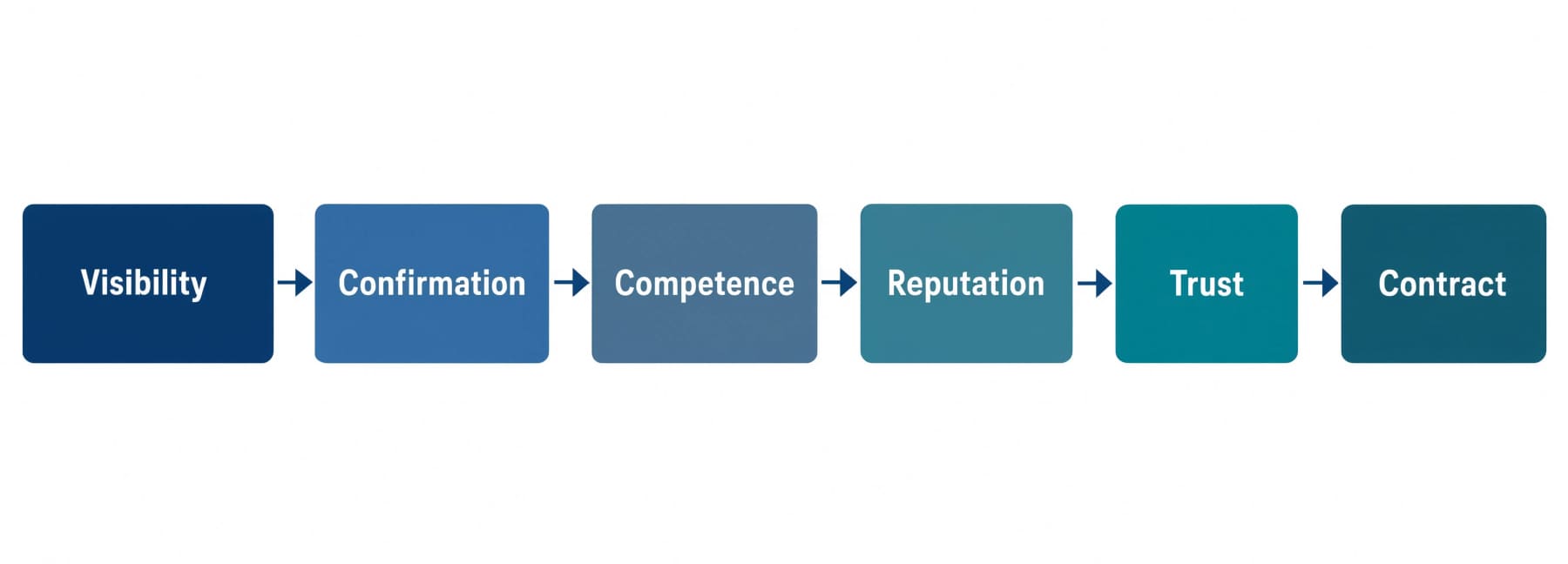
1. Visibility
At the foundational phase, the enterprise must maintain a physical and algorithmic presence within the buyer's global search results. Importers search for solutions to their logistical or assortment requirements within specialized digital marketplaces, global databases, and trading platform ecosystems.
What happens: An automated or manual screening of the information landscape is executed, through which the importer's procurement committee establishes an initial pool of potential counterparties.
Why it happens: Modern procurement professionals seek to minimize sourcing overheads and heavily rely on vetted digital ecosystems that aggregate verified intelligence regarding manufacturers.
The consequences: If a manufacturer lacks a presence on core global B2B platforms or if its website isn't indexed by search algorithms for target commodity codes, it risks remaining invisible to most buyers. The enterprise loses a substantial share of incoming organic demand before the importer even allocates procurement budgets. While a lack of B2B platform presence compromises visibility, it does not entirely eliminate the vendor if they maintain an exceptional footprint across search engine indices.
Why the solution works: Establishing a multi-channel digital presence via verified B2B profiles and end-to-end catalog SEO guarantees inclusion in the buyer's shortlist from day one of demand generation. This unlocks access to private tenders and direct RFQs from top-tier distributors.
2. Confirmation
Upon discovering the company's profile, the importer proceeds to verify its fundamental legal and physical legitimacy. The procurement team must substantiate to their internal corporate security division that the counterparty is not a shell entity.
What happens: The buyer cross-references corporate registration records, checks domain registries, validates the factory's location via satellite maps, and verifies the ultimate beneficial ownership (UBO).
Why it happens: The international trade landscape features unaccredited brokers and fraudulent configurations masquerading as large manufacturing facilities to secure upfront deposits or free premium raw material samples.
The consequences: Discovering corporate correspondence originating from public email domains or identifying discrepancies between registered legal entities and actual manufacturing coordinates triggers immediate lead rejection. The importer terminates the audit session, classifying the supplier as a high-risk entity exhibiting shell-company characteristics.
Why the solution works: Transparent disclosure of official corporate registration numbers, standardizing operations on corporate web domains, and displaying precise geotags of physical production units immediately mitigates initial concerns about fraud. The importer obtains documented verification of the business's operational reality.
3. Competence
At the third tier, the importer evaluates the manufacturer's technological and regulatory capacity to produce the necessary volumes and qualities compliant with the target market's legal frameworks.
What happens: The procurement committee executes a rigorous technical audit of publicly available specifications, quality control matrices, packaging configurations, and regulatory permits.
Why it happens: The importer is hedging against border regulatory blockades and technological incompatibility between the raw materials and their own manufacturing lines or downstream retail mandates.
The consequences: The absence of detailed specifications or the concealment of international certification credentials prompts the buyer to question the supplier team's professional competence. They deduce that the enterprise has immature export workflows and terminate the evaluation due to the unacceptably high risk of product spoilage or seizure of goods by regulatory authorities.
Why the solution works: Consistently displaying current HACCP, ISO, or FSSC certificates alongside exhaustive logistical product sheets addresses all technical inquiries upfront. This positions the enterprise as an accredited, predictable partner structurally equipped for rigorous regulatory compliance.
4. Reputation
Having verified technological competence, the importer actively seeks independent validation of the supplier's successful execution history with other international accounts.
What happens: The buyer parses cross-border customs registries, requests references from accredited trade associations, and reviews verified transactional feedback on neutral trading networks.
Why it happens: Since any commercial entity is inherently inclined to overstate its capacities within marketing collateral, corporate buyers place exclusive trust in external, objective, and mathematically verifiable data indices.
The consequences: If a manufacturer's claims of "global distribution" are contradicted by blank customs ledgers or hidden litigation records, the trust index drops to zero. The importer terminates all communication, unwilling to serve as an experimental environment for an unproven counterparty's operational mistakes.
Why the solution works: Maintaining a transparent digital ledger of fulfilled cross-border shipments and authenticated peer reviews from active importers on neutral B2B networks functions as the ultimate social proof. This completely eliminates concerns regarding operational incompetence.
5. Trust
Once all preceding filters are successfully cleared, the importer develops both a subjective and objective sense of security regarding the impending deal. Calculated operational risk is brought down to an acceptable minimum threshold.
What happens: The importer's procurement committee moves the supplier from the "potential risk" tier to a "strategic priority" status, proactively initiating contact to finalize commercial parameters.
Why it happens: The robust and transparent corporate digital footprint has eliminated the systemic information asymmetry, empowering the procurement officer to easily justify the vendor selection to the corporate finance department and executive board.
The consequences: The exporter secures a high-intent, high-conversion inquiry, where negotiations bypass fundamental verification hurdles and pivot immediately to specific logistics frameworks and contract volume matrices. Deal closure accelerates dramatically.
Why the solution works: Established corporate trust drastically reduces the subjective risk premium typically built into pricing by foreign importers. This permits the exporter to negotiate from a position of commercial leverage, maintaining higher margins.
6. Contract
This is the final phase of the trust architecture, transforming accumulated digital trust equity into binding legal frameworks and structured financial obligations between counterparties.
What happens: Counterparties finalize and execute a long-term international supply agreement, deploy structured financial instruments (letters of credit, advance payments), and map out systemic shipping schedules.
Why it happens: Enterprise-scale B2B contracts are finalized exclusively when both organizations possess absolute confidence in the partner's reliability across a multi-year horizon.
The consequences: The enterprise locks in a guaranteed distribution pipeline, secures optimized utilization of manufacturing capacities, and expands its proven export track record—automatically strengthening its market leverage for future client acquisition.
Why the solution works: Operationalizing trust into a finalized master agreement proves that data transparency and digital reputation management serve as the most potent instruments for reducing transactional overheads in modern international trade practices.
Practical Exporter Checklist: Audit of Readiness for International B2B Sales
This block is designed as a ready-made structure for creating corporate infographics. Each element corresponds to a specific measurable KPI, enabling an express audit of the company's export infrastructure.
Block 1. Digital Infrastructure and Interfaces
-
Web Resource Language Localization
- Criterion: Flawless translation of all website sections into English or the target market's language. Stock machine translation tools are completely excluded.
-
Technical Depth of the Product Catalog
- Criterion: Public availability of detailed specification sheets, precise HS codes, storage temperature parameters, and weight/dimension characteristics of transport packaging.
-
Legitimacy of Communication Channels
- Criterion: All RFQ responses and proposals must be sent strictly from corporate email accounts on the company's own domain. The use of public services like Gmail or Yahoo is prohibited.
-
Inbound Response Time (SLA)
- Criterion: The standard regulatory timeframe for the initial processing of international leads is no more than two hours during business hours.
Block 2. Regulatory and Legal Compliance
-
Accessibility of Regulatory Documentation
- Criterion: Placement of valid HACCP, ISO, and BRC certificates directly on the company's digital showcase with online serial number verification. For EU and US markets—additional confirmation of registration in TRACES/BCP and FDA/FSVP respectively.
-
Corporate Structure Transparency
- Criterion: Presence of direct legal entity registration data, factory history, and actual physical coordinates of production sites on the website.
-
Legal Brand Cleanliness
- Criterion: Absence of open international arbitration disputes or registered claims from regulatory or fiscal authorities in the country of origin.
Block 3. Human Capital and Team Verification
-
Corporate Presence on LinkedIn
- Criterion: Active, verified organization page on the professional network with regular updates on the factory's operational life.
-
Profiles of Key Decision-Makers
- Criterion: Detailed, active profiles for the export director, chief food technologist, and head of export operations linked to the company page.
-
Multilingualism of the Export Team
- Criterion: Export department managers are fluent in Incoterms 2020 terminology and capable of conducting complex phone or video negotiations without third-party interpreters.
Block 4. Trade Track Record and Social Proof
-
Anonymized Export Case Studies
- Criterion: Publication of real shipment histories detailing global regions, transport equipment classes (e.g., 40-foot reefer containers), and descriptions of resolved logistical challenges.
-
Verified Reviews on Neutral Platforms
- Criterion: Presence of peer-reviewed evaluations and ratings on independent international B2B platforms where moderation rules eliminate review manipulation.
-
Institutional Recommendations
- Criterion: Enterprise inclusion in official reliable exporter registries managed by national Chambers of Commerce or target Ministries of Agriculture.
Why Trust Becomes a Competitive Advantage: The Macroeconomics of Commercial Preferences
Driven by the margin compression gripping the global food market, legacy differentiators like proprietary flavor profiles or flexible pricing frameworks are rapidly shedding their exclusivity. Achieving production technology parity means hundreds of facilities worldwide can supply identical items at practically identical baseline costs. Consequently, the primary vector of competitive differentiation between exporters shifts from the product itself to the depth of the importer's transaction cost reduction through trust capitalization.
Institutional trust, expressed through a transparent digital footprint, translates directly into measurable financial metrics for the exporter. It optimizes four critical dimensions of cross-border B2B transactions.
The Impact of Trust on Conversion Rates and Sourcing Cycle Compression
Elevated data transparency fundamentally reshapes lead progression dynamics through the export sales funnel.
What happens: Interfacing with a verified vendor compresses a standard cross-border transaction timeline from a conventional 6–9 months down to a few weeks.
Why it happens: The importer is liberated from tedious manual investigations, physical documentation requests, and financing expensive onsite audits. Information symmetry enables the procurement committee to make choices based on instantly accessible digital proof points.
The consequences: Customer Acquisition Cost (CAC) scales down significantly, while the exporter's team stops tying up working capital in stalled, protracted negotiations. Liberated operational resources are diverted to scale up delivery volumes.
Why the solution works: The open data architecture embedded in the exporter's profile acts as an operational catalyst. The buyer recognizes absolute regulatory compliance maturity in the initial seconds of the session and moves the company to the order generation stage.
Shifting the Balance of Power in Negotiations
Established corporate trust dissolves the rigid asymmetry where the importer dictates transaction parameters from a position of unchecked leverage.
What happens: The supplier obtains the operational leverage to establish favorable financial terms, including securing partial or full advance payments, alongside deploying irrevocable letters of credit instead of yielding to deferred payment schedules.
Why it happens: The underlying driver behind rigid post-payment mandates is the importer's fundamental anxiety regarding liquidity loss should a foreign production unit fail to deliver. When the vendor's default risk is verified close to zero, this anxiety vanishes.
The consequences: The exporter insulates the enterprise against cash-flow gaps and avoids taking on expensive financing to source raw materials for contract execution. Corporate fiscal stability increases.
Why the solution works: Showcasing an unblemished export record and transparent beneficial ownership matrices neutralizes the importer's baseline defensive barriers. The dialogue transitions toward true parity.
Capitalizing on a Price Premium (The Trust Premium)
Industrial B2B market dynamics demonstrate that retail network buyers and large industrial groups are fully prepared to absorb a price premium for operational consistency.
What happens: A highly transparent exporter can command prices 7–12% above localized industry averages without losing market share to price-cutting competitors.
Why it happens: The importer views this price difference as an insurance premium securing a guaranteed On-Time In-Full (OTIF) delivery metric. They recognize that sourcing cheaper goods from an anonymous, unvetted entity injects risk of compounding retail penalties that instantly overwrite immediate invoice savings.
The consequences: Export profitability metrics stabilize, insulating the business from raw material and energy price shocks. Operational trust transforms into an engine generating pure bottom-line profit.
Why the solution works: The TCO financial framework applied by corporate buyers mathematically substantiates the net benefit of dealing with predictable counterparties. A supplier with verified compliance benchmarks validates pricing not via marketing buzzwords, but by mitigating the buyer's operational risk calculations.
Securing Long-Term Relationship Retention and Customer Lifetime Value (LTV)
Retaining an active B2B account is vastly more cost-efficient than converting a new partner within an unproven geographical territory. According to studies compiled by the Harvard Business Review, acquiring a new customer can be 5–25 times more expensive than keeping an active one, depending on industry verticals and business models. For industrial B2B firms, the typical multiplier is 7–10 times, and for global trade with long contract cycles and high transaction costs, this multiplier frequently climbs higher.
What happens: Supply agreements with transparent vendors are routinely extended for years, while the importer's procurement volumes grow steadily year over year.
Why it happens: Replacing an active supplier in the Food & Beverage sector is an intricate, high-risk operational process demanding redundant laboratory verifications, customs clearance updates, and supply chain calibration. Importers avoid these additional costs if the active partner delivers consistent performance.
The consequences: The exporter secures a highly predictable order book for multiple years ahead. This empowers the enterprise to confidently schedule capacity upgrades and invest in new product development with reduced market risk.
Why the solution works: Continuously maintaining data transparency and digital asset integrity strengthens the partnership between business partners. The exporter integrates deep into the importer's operations, transitioning into an indispensable part of their value chain.
Comparative Analysis of Negotiation Positions Based on the Trust Factor
The comparison framework below demonstrates how a well-capitalized digital reputation radically alters foreign trade transaction parameters, assuming all underlying product metrics remain constant.
| Commercial Transaction Parameter | Supplier with a Trust Deficit (Anonymous Profile) | Supplier with Capitalized Trust (Transparent Profile) |
| Baseline Negotiation Leverage | Forced to accept buyer mandates; vulnerable to aggressive pricing pressure | Engages as an equal partner, backed by verified operational maturity |
| Contract Financial Terms | Deferred payment schedules spanning 60 to 90 days post-customs clearance | Advance payment structures (30/70) or deployment of confirmed letters of credit |
| Due Diligence and Onboarding Timeline (KYC) | From 3 to 6 months of drawn-out audits by security units | Accelerated compliance—ranging from a few hours to 2–3 business days |
| Resilience Against Competitor Price-Dumping | Low. The client migrates instantly upon encountering an alternative 3% discount proposal | High. The importer disregards dumping attempts to insulate their OTIF consistency |
| Long-Term Growth Potential | Restricted to transactional spot deals during localized raw material shortages | Strategic partner status paired with automated annual volume allocation increases |
The Future of Trust in International Trade: Shifting to Algorithmic Ecosystems
The classical model of international trade anchored in interpersonal networking, handshakes, and referrals within a narrow circle is obsolete. The vector of global B2B expansion points toward interconnected digital spaces where objective, machine-readable data matrices and decentralized validation networks play the decisive role. By 2030, an enterprise's capacity to manage its digital reputation will be a prerequisite for maintaining its international commercial viability.
The contemporary trust architecture in global commerce is materializing around five core technological pillars.
Transforming Digital Reputation Into an Immutable Asset
The concept of reputation is being stripped of subjective elements and translated into a quantitative index. In the coming years, international procurement will rely on dynamic scoring models that evaluate thousands of performance data generated by the exporter in real time. This includes precise data regarding logistical schedule accuracy, phytosanitary audit pass rates at border posts, and the corporate entity's fiscal health metrics. This intelligence cannot be simulated or optimized via marketing spend, as it is anchored in distributed ledgers and sovereign state agency databases.
The Evolution of Specialized Trade Platforms
B2B platforms are expanding beyond simple bulletin boards or catalog directories. They are evolving into comprehensive ecosystems acting as neutral arbiters for transparency and risk mitigation in cross-border transactions. Contemporary networks assume the functions of independent arbiters and technological validators. Rather than merely connecting buyers and suppliers, they deliver end-to-end participant verification and significantly reducing transaction costs. Implementing these infrastructural solutions enables mid-market and enterprise businesses to completely address operational concerns when expanding into unfamiliar markets.
Total Operational Data Transparency and API Integration
Future importers will demand direct access to a supplier's internal production and supply chain data. The future belongs to enterprises prepared to integrate their ERP systems with external trading platforms via secure communication protocols. A buyer will have real-time visibility into production line capacity utilization, warehouse raw material levels, and real-time tracking of shipments. This level of transparency eliminates intermediary friction and reduces mutual audit costs.
Instant Automated Online Corporate Verification
Compliance processes (Know Your Customer / KYC operations) are becoming real-time processes. Manual registry searches and notarized articles of incorporation are being replaced by automated screening across specialized data hubs. In fractions of a second, artificial intelligence compiles an exporter's legal profile across all accessible state registries, checks license validity periods, and generates a comprehensive risk report for the buyer. Suppliers whose data profiles are not structured for automated processing will be excluded by automated systems at the initial screening phase.
Digital Export Profiles as Standardized Capability Passports
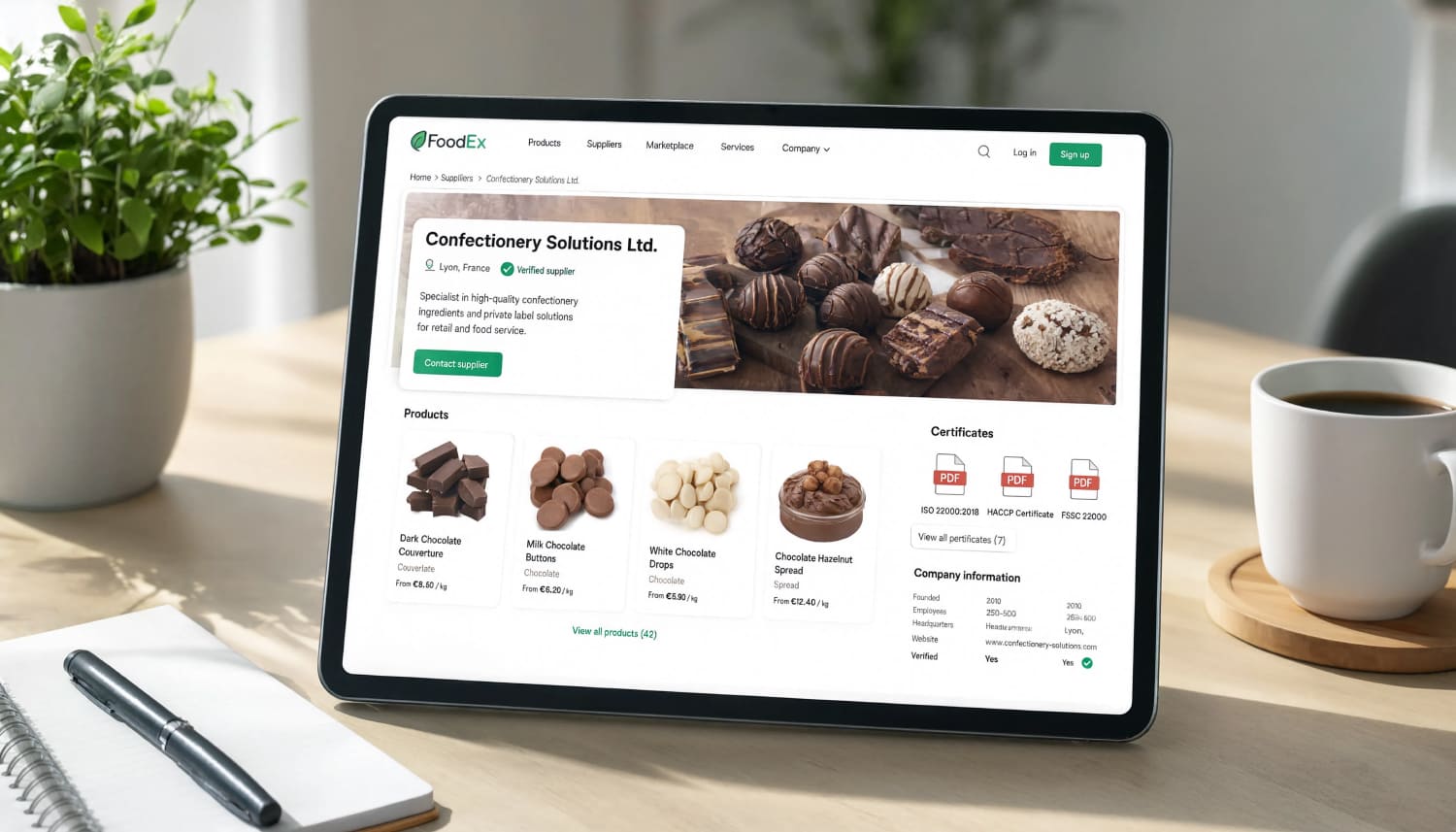
The traditional corporate website is giving way to standardized export profiles on global trade hubs. These profiles operate as digital enterprise passports, where all parameters are aligned with a standardized international format optimized for both human procurement officers and search engine crawlers. This is where verified certificates, real-time price sheets linked to commodity market prices, and interactive freight calculators reside. Maintaining this passport proves to the global market that the manufacturer is fully prepared to integrate into modern international supply chains.
Conclusion
The fundamental miscalculation of most enterprises seeking to scale internationally lies in misidentifying the true core object of a B2B transaction. Sales executives and brand owners continue to operate within a legacy product-centric paradigm. They remain convinced that an importer is buying a ton of grain, a pallet of confectionery, or an ocean container of frozen protein.
Rigorous analysis of buyer behavior across global markets disproves this assumption.
In modern cross-border commerce, the importer does not buy a physical product. They are purchasing certainty—the assurance that a foreign vendor possesses the operational maturity, financial stability, and regulatory competence required for the consistent performance of their contractual obligations.
Minimizing operational uncertainty has become the top priority in international trade. An exporter may offer the highest-quality product worldwide and put forward the lowest prices in the industry, but if their digital footprint signals uncertainty, instability, or anonymity, they remain completely invisible to enterprise-scale buyers. Investments in data transparency, maintaining a spotless digital reputation, and integration into algorithmic ecosystems are not optional marketing expenses; they represent core strategic investments in long-term business value.
The global commercial landscape is rapidly eliminating opaque middlemen and unstable business structures. Contemporary international supply chains are increasingly relying on specialized technology and B2B platforms. Specialized B2B marketplaces play a pivotal role in this structural shift, providing comprehensive participant verification and significantly reducing transaction costs. Victory in this new operational paradigm belongs to those manufacturers who are the first to replace cultures of opacity and anonymity with a philosophy of digital openness, transforming institutional trust into their ultimate competitive advantage.
About the AllFoods Market Platform
AllFoods Market is an international B2B platform for the food sector, designed to enhance digital corporate visibility and reduce transaction costs when expanding into new geographic regions. The platform delivers a highly efficient toolkit for manufacturers and distributors to construct comprehensive public profiles and verify their company information. A dedicated module for displaying international certificates empowers exporters to demonstrate their regulatory compliance, enabling importers to quickly find reliable partners during the initial pre-screening phase.
Latest blog posts
-
Top 10 Supermarket Chains in Austria: A Brief Overview
Austria’s grocery retail market brings together national chains, international groups, discounter...
-
Top 10 Supermarket Chains in Belgium: A Brief Overview
Belgium’s grocery retail sector brings together national chains, international groups, discounter...
-
Olive Oil Producers in Spain for B2B Sourcing
Spain's olive oil sector combines cooperative mills, industrial processors, refiners, bottlers, a...
-
Top 10 Largest Grocery Chains in Italy
Italy’s grocery market is divided among cooperative groups, national supermarket brands, internat...
-
Top 10 Largest Grocery Chains in Sweden: A Brief Overview
An overview of Sweden's largest grocery retail chains, including store formats, geographic covera...


Categories
- Reviews of products and manufacturers
- Allfoods Market System Features
- Market Insights
- Food Technologies
Latest posts in partners' blogs
-
Uzbekistan Food Exports and Key Markets
Uzbekistan’s food exports are expanding well beyond fresh produce. Fruit, vegetables, flour, mung...
-
Kazakhstan Food and Agricultural Exports
Kazakhstan’s export offer extends well beyond wheat and other grains. International buyers can al...
-
Alpine Beef Ribeye: The Pinnacle of Flavor and Excellence for Your HoReCa and Retail Business
The Perfect Steak Starts with a Name: Alpine
-
Uganda Agricultural Exports and Key Products for B2B Sourcing
Uganda’s agricultural export profile is dominated by coffee, but the commercial picture is broade...
-
Food Exports from Morocco
Morocco’s food export profile extends well beyond citrus and olive oil. Fresh tomatoes, berries, ...