

 Español
 Русский

The Export Demand Illusion in Inbound B2B Trade
Table of Contents:
- The Inbound Traffic Paradox in International Trade
- The Anatomy of False Demand: Who is Really Sending Export Inquiries
- The Economics of Illusion: The True Cost of Unqualified Inquiries
- Seven Signs of a Weak Export Inquiry
- Verification Methodology: How Professional Exporters Qualify Buyers
- A Practical Importer Verification Checklist
- Infrastructure Transformation: The Future of Buyer Qualification
- Conclusion: Moving from Funnel Volume to Margin Density
The Inbound Traffic Paradox in International Trade
A typical scenario in the international trade department of a large or medium-sized food manufacturer unfolds as follows: following participation in an international trade fair (such as FruitLogistica, Gulfood, SIAL, or Anuga) or the launch of a campaign on general B2B platforms, the company's corporate inbox floods with dozens of inquiries for price lists, specifications, and delivery terms. The Commercial Director records a sharp increase in the "number of prospects" metric, while the export department shifts into overtime mode—calculating logistics under Incoterms, adapting commercial offers, and aligning cost calculations with the production unit.
However, after 4–6 months of intensive correspondence, a systemic crisis emerges: hundreds of emails sent, dozens of custom calculations prepared, and samples dispatched via express mail yield a zero or near-zero result. According to industry research, the conversion rate from an inbound inquiry to a signed contract and actual payment (letter of credit/advance payment) in the international food and beverage segment ranges from 1% for inquiries from general B2B platforms to 5–10% for qualified leads from industry trade shows.
According to MarketJoy data, the average conversion rate at the Opportunity → Closed-Won stage in the B2B segment is 6–9%, with the steepest drop-off occurring at the MQL → SQL stage (12–18%), which is driven by marketing handing over leads that are not sales-ready. For the food segment, these figures are even lower due to logistics complexities and regulatory barriers. According to WordStream (2024), the average B2B lead conversion rate stands at 2.3%, while high-performing companies achieve 10%. Concurrently, an Unbounce study (analyzing 41,000 landing pages and 57 million conversions) revealed a median conversion rate for B2B landing pages of 6.6%; however, for the SaaS segment, it drops to 3.8%, demonstrating high variability depending on product complexity and the deal cycle.
Why Does a High Volume of Inquiries Not Translate to Proportional Sales Growth?
At the core of this paradox lies a fundamental shift in the architecture of global B2B communications. The digitalization of international trade has reduced the marginal cost of sending an export inquiry to virtually zero. Today, a prospective buyer needs only a few clicks or a blast broadcast across messaging apps to trigger deep analytical work across dozens of manufacturing plants.
Conversely, the cost of processing such inquiries on the exporter's side remains exceptionally high. The food sector demands strict specification: calculating temperature-controlled logistics, verifying phytosanitary requirements of the destination country, ensuring Halal/Kosher compliance, and customizing packaging and labeling to match the importer's local legislation.
This creates a critical informational and economic asymmetry: a buyer spends 10 seconds sending a template, while the supplier's export manager invests anywhere from 4 to 16 working hours gathering internal information, calculating the logistics leg, and preparing a cost sheet. Consequently, without management realizing it, the export department morphs into a free consulting and market intelligence agency for entities that never possessed the capacity, budget, or intention to execute a transaction.
Professional exporting does not begin with the ability to sell to anyone who writes; it begins with the rigorous and clinical qualification of the inbound flow.
The Anatomy of False Demand: Who is Really Sending Export Inquiries
To build an effective filtering system, one must understand the structure of inbound "noise." The entities and individuals generating non-converting inquiries in the food and agribusiness sector fall into eight primary categories. Each has its own underlying motivation and behavioral patterns.

It is important to emphasize that belonging to any given category does not inherently make a counterparty bad-faith. For instance, professional trading houses, export agents, and brokers are frequently vital links in global supply chains. The discussion below pertains strictly to instances where a counterparty's behavior indicates an absence of genuine commercial intent or an attempt to offload their own risks and expenses onto the supplier.
Competitors (Covert Price Monitoring)
Motivation: Market monitoring, replication of export strategies, undercutting.
Behavior: They operate under the guise of regional distributors or fictitious trading companies (frequently registering burner domains or writing from free email services like Gmail or Yahoo). Their objective is to secure your export price list, determine the minimum order quantity (MOQ), uncover deferred payment terms, and acquire product technical sheets.
Why it happens: In environments of fierce international competition (such as the grains, vegetable oils, or confectionery markets), maintaining margins depends heavily on knowing a competitor's costs. Armed with your commercial offer calculated CIF Shanghai or FOB Novorossiysk, a competitor fine-tunes their proposal for key importers to sit 0.5–1% below your price.
Speculative Intermediaries and Non-Exclusive Brokers
Professional trade intermediaries should not be confused with speculative brokers who lack a verified mandate or order portfolio. The former assist manufacturers in entering new markets and generate added value. The text below focuses exclusively on the latter category.
Motivation: Securing a back-to-back transaction without deploying personal capital.
Behavior: They request maximum possible volumes (e.g., "50 containers of frozen poultry per month" or "10,000 tons of sugar") and demand the execution of a Non-Circumvention and Non-Disclosure Agreement (NCNDA) prior to disclosing any profile of the end-buyer. They insist on unrealistic payment terms, such as 100% deferment or payment upon arrival at the destination port without bank guarantees.
Why it happens: These agents possess neither a physical retail/wholesale network nor standing contracts with retail chains. They try to "hedge" the manufacturer's offer to subsequently scout for a real importer across Southeast Asian or Middle Eastern markets. If they fail to secure a buyer (which occurs in 98% of cases), they simply vanish, leaving the export department with a stack of obsolete calculations. This assessment is validated by international trade realities: according to the Canadian Food Inspection Agency (Food Fraud Report 2022–2023), 62% of high-value oils and 32% of spices subjected to targeted inspection showed signs of non-compliant practices, pointing to a heavy presence of speculative intermediaries in food supply chains. In the B2B export segment, a proxy's lack of a confirmed order book, exclusive rights, or standalone logistics infrastructure serves as a primary hallmark of a speculative inquiry.
Price Compliance Agents (Tender Price Gatherers)
Motivation: Fulfilling internal bureaucratic procedures or audit requirements.
Behavior: The inquiry originates from a real, often large enterprise or a state entity. Strict specifications are requested under tight deadlines. The manager demands the completion of intricate, multi-page forms, the submission of international certifications (ISO, HACCP, BRC), and a final binding price. Once the documents are delivered, communication ceases instantly.
Why it happens: The buyer already has an approved pool of vendors and a designated tender winner. However, bound by corporate policy or procurement legislation, they must demonstrate to the board or state auditors that they executed 'market compliance' by gathering at least 3–5 alternative bids. Your company is merely utilized as a data point to legitimize a contract with their long-standing partner.
Novice Importers
Motivation: A desire to enter the high-margin food import business without understanding market infrastructure.
Behavior: Inquiries are highly expressive and contain abstract phrasing (e.g., "we want to import your premium cookies to India, the market is huge"). Buyers in this category are unaware of HS codes, unfamiliar with their country's customs tariffs, lack import licenses (such as the FSSAI central license and IEC code in India or registration in China's customs declaration system), and are genuinely surprised that a manufacturer cannot dispatch a single consolidated pallet via standard unrefrigerated domestic transport across three borders.
Why it happens: The barrier to entry into the information space has collapsed. The owner of a small local shop or ethnic supermarket in the EU or US believes they can purchase directly from factories on the same terms as multinational distributors, completely ignoring the costs of port forwarding, demurrage, customs clearance, and minimum freight requirements.
Market Researchers and Consulting Analysts
Motivation: Gathering primary research data utilizing the supplier's resources.
Behavior: Inquiries masquerade as prospects for long-term partnerships. They request granular details on cost structure, unallocated production capacity, raw materials utilized, logistics routes, and packaging specifications. Questions of a macro-economic nature are frequently interspersed.
Why it happens: Certain boutique consulting agencies and freelance analysts contracted by larger firms deploy fake inquiries to harvest primary data as an alternative to purchasing costly databases. Instead of paying for proprietary data, they initiate sham procurement sessions, extracting manufacturers' trade secrets under the pretext of "evaluating partnership potential."
Buyers Without a Budget
Motivation: Attempting to secure factory-wholesale pricing for retail or small-wholesale consumption volumes.
Behavior: They haggle aggressively over every cent, demanding discount tiers reserved for "100+ tons," yet when finalizing the initial shipment volume, they attempt to lock in a purchase of just one or two pallets while promising "explosive volume growth next quarter."
Why it happens: Local HoReCa distributors or modest regional wholesalers try to bypass the domestic layer of major national importers. They fail to realize that ocean freight, customs duties, and certification fees applied to a single pallet make the unit cost astronomical, while the manufacturer's time investment to process an export customs declaration is identical whether it is for one pallet or an entire vessel cargo lot.
Professional Scammers
Motivation: Misappropriation of funds via registration fees, cargo theft, or phishing.
Behavior: They display a surprisingly flawless alignment with formal criteria, sending official letterheads that mimic ministries or conglomerate designs (e.g., counterfeit ECOWAS tenders in West Africa or bogus inquiries from UAE oil-drilling companies for workforce catering supplies). They accept your pricing without negotiation, but during onboarding, they demand payments for an "obligatory vendor registration fee in the state registry," "legal contract notarization in a local court," or attempt to execute malicious software via links leading to "procurement documentation."
Why it happens: Global food trade is a highly liquid marketplace. Food commodities are easily liquidated goods, though their physical resale requires cold-chain or storage infrastructure. Consequently, fraudsters more commonly deploy schemes involving advance payments and fictitious registration fees rather than physical cargo hijacking. They capitalize on the vanity and oversight of export managers eager to close a major contract.
Free Sample Hunters
Motivation: Stocking their own retail business, artisanal bakery, coffee shop, or personal pantry free of charge.
Behavior: Exceptionally engaged during the initial phase, they express profound interest in the product line and rapidly agree on a product matrix for "local market testing." The primary red flag: they adamantly refuse to pay for express sample delivery (DHL, FedEx) or provide a corporate account number for freight-collect billing.
Why it happens: In premium product categories (confectionery, honey, nuts, high-end cheeses, alcohol, specialty coffee), compiling free samples from 20–30 factories allows micro-entrepreneurs or content creators to assemble inventory or media assets with zero raw-material acquisition costs.
Structural Breakdown of Inbound Inquiries (Food & Beverage Segment)
| Inquiry Category | Genuine Objective | Exporter Overhead / Sunk Costs | Business Risk Level |
| Competitors | Commercial espionage, price benchmarking | Price strategy leakage, loss of USP | High (direct economic damage) |
| Speculative Brokers | Attempting to flip goods without liabilities | Dozens of logistics calculation hours, quota locking | Medium (loss of export team hours) |
| Price Gatherers (Compliance) | Creating a sham tender to check a box | Sunk costs in compiling complex tender dossiers | Low (pure loss of working hours) |
| Novice Importers | Self-validation, hypothetical business model | Educating the prospect on trade basics at company expense | Medium (clogs the funnel with false expectations) |
| Market Researchers | Compiling paid intelligence reports | Leakage of internal analytics and production data | Low (unpublicized information leakage) |
| Micro-Wholesale Entities | Attempting to acquire retail volumes at wholesale scale | Customizing quotes for an unviable volume lot | Medium (dilutes team focus) |
| Fraudsters | Direct asset theft (advance fees) | Financial loss, legal liabilities | Critical (insolvency threat) |
| Sample Hunters | Free product consumption | Overhead on sample fabrication and logistics | Low (minor direct overhead) |
The Economics of Illusion: The True Cost of Unqualified Inquiries
In corporate finance, there is a concept of "opportunity cost"—the foregone benefit as a result of choosing one alternative option for resource allocation over another. In international trade, this law operates with extreme rigor. Most companies evaluate marketing and sales expenditures based on direct costs: budgets for trade show participation, subscription fees for B2B platforms, and the base salary of export sales managers. This approach obscures the true operational losses inflicted on a company by an unmanaged influx of "junk" inquiries.
Direct and Hidden Operational Costs
Every inbound inquiry that is processed without prior qualification triggers an end-to-end chain of processes requiring the involvement of a cross-functional team. The export manager performs an initial communication analysis, engages the logistics department to calculate complex multimodal freight, forwards documents to the legal department to screen for sanctions risks and currency compliance, and requests input from food technologists and the production block to evaluate the raw material base and adapt formulations to the destination country's regulations.
When quantifying this time through the hourly rates of specialists, the cost of a single customized commercial proposal for overseas markets can range from $150 to $600, excluding the costs of manufacturing and express delivery of physical samples. If an export department processes 40 non-targeted inquiries per month, the company loses up to $12,000 of its net operational budget monthly on servicing false demand.
The calculation is based on the total cost per lead methodology (collateral + labor formula) described in B2B marketing studies: the cost comprises direct marketing expenditures and indirect team labor costs. According to Lusha, when accounting for salaries and outsourcing, the cost of a single B2B lead can scale from $100 (advertising costs only) up to $700 (inclusive of specialist labor costs). In international food trade, this figure inflates due to the mandatory involvement of food technologists, logistics experts, and legal counsels for each inquiry. An Aberdeen Group study demonstrated that replacing a B2B manager costs a company over $29,000 and requires more than seven months, making the time utilization efficiency of the export department a critically vital metric.
The Speed Penalty: Opportunity Cost on Genuine Buyers
In B2B sales, response speed is a critical determinant of conversion. A Harvard Business Review study (2011, auditing 2,241 US companies) showed that the average response time to an inbound inquiry is 42 hours, with 23% of companies failing to respond at all. Companies that connect with a potential client within one hour of receiving an inquiry are 7 times more likely to qualify the lead than those responding after 24 hours. Separate research by MIT/InsideSales.com (2007, Prof. James Oldroyd, 15,000+ leads, 100,000+ calls) revealed that the likelihood of establishing contact drops 100-fold with a delay from 5 to 30 minutes, and the probability of qualification decreases 21-fold. In international food trade, where an inquiry mandates alignment with production and logistics, confirming receipt within 24 hours while indicating the timeline for a comprehensive response is considered realistic.
When an export manager is overwhelmed with compiling estimations for brokers or price-gatherers, a genuine buyer from a major retail chain (such as LuLu Group in the Middle East or Jerónimo Martins in Europe) waits three days for a response. By the time your manager becomes available and sends the calculation, the buyer has already signed a contract with a more agile competitor from Poland or Turkey. High-margin transactions are effectively displaced by routine noise.
Team Burnout and KPI Distortion
The lengthy sales cycle in international trade (ranging from 3 to 9 months) already imposes a substantial psychological load on the team. When an export sales manager executes hundreds of iterations—making calls, debating packaging customization with the production team, negotiating discounts with logistics providers—and sees no closed contracts month after month, professional burnout occurs. The employee loses focus and begins to treat all inbound inquiries with identical cynicism, which degrades the quality of engagement even with targeted clients.
Concurrently, the data-driven management system breaks down. Leadership observes excellent dynamics in the CRM: the funnel is saturated, managers are operating at maximum capacity, and activity-based KPIs are exceeded. Based on these "vanity metrics," flawed strategic decisions are made: the export department's headcount is expanded, new exhibition spaces are purchased, and budgets for inefficient promotion channels are increased. In reality, the company is investing in scaling the process of handling defective leads rather than actual sales.
The concept of "vanity metrics"—indicators that create an illusion of success but do not aid in making data-backed managerial decisions—was introduced by Eric Ries in his book "The Lean Startup" (2011). Ries defined them as metrics that "make you feel good but don't offer clear guidance for action." In the context of export sales, typical examples include the "number of sent commercial proposals," "number of inbound inquiries," and "manager's working hours," none of which reflect conversion into contracts and revenue. According to the HubSpot State of Marketing Report (2026), only 35% of marketers consider understanding the ROI of their campaigns to be "very important" or "extremely important," which explains the prevalence of management driven by vanity metrics.
Seven Signs of a Weak Export Inquiry
Professional compliance is built upon the deconstruction of the inquiry's text and the analysis of the counterparty's digital footprint. Let us examine seven critical markers signaling that an inquiry, with a high degree of probability, will prove non-converting.
1. Public Email Domains Accompanying Large-Scale Volumes
- Why it happens: An inquiry to purchase 10 containers of milk powder arrives from john.procurement1990@gmail.com or trade-lead-company@yahoo.com. The sender attributes this to "technical glitches on the corporate server" or "confidentiality prior to contract signature." In reality, the company either completely lacks a website and registered legal entity, or it is a competitor obscuring its identity.
- How dangerous it is: The risk is critical. A large systemic importer never conducts commercial correspondence via free email services—this violates internal security and compliance protocols.
- Exceptions: Countries with strict state regulation of the internet or a specific business culture in its initial phases (e.g., small family businesses in certain regions of West Africa or Latin America). However, even they provide corporate credentials upon proceeding to structural details.
- Correct response: A polite refusal to provide price specifications until an inquiry is submitted from an official corporate domain. Response template: "In accordance with our company's security policy, we provide commercial proposals exclusively to official corporate addresses..."
2. Absolute Logistics Vacuum and Price Indifference
- Why it happens: A buyer writes: "Please send your best prices for the entire confectionery range. Any delivery terms are acceptable to us, send the price list." The inquiry lacks an Incoterms delivery basis (FOB, CIF), a destination port, requirements for remaining shelf life, and a shipment schedule. This is a classic hallmark of price gathering by competitors or market analysts. A genuine buyer is always constrained by their country's internal logistics matrix and customs tariffs.
- How dangerous it is: High risk of wasted time. Without understanding the final delivery point, a price calculation is meaningless, as logistics can represent from 10% to 40% of the final cost of food products.
- Exceptions: An initial exploratory inquiry at an international trade fair, where a buyer collects catalogs. In digital correspondence, however, this is unacceptable.
- Correct response: Do not send the price list. Reply with a brief consisting of three questions: the HS code of the product of interest, the delivery basis (e.g., CIF Shanghai), and the planned volume of the trial batch. False inquiries are filtered out at this stage in 90% of cases. This figure is validated by the practices of major export departments in the food industry: when implementing a mandatory 3-question brief (HS code, delivery basis, trial batch volume), the proportion of unqualified inquiries reaching the commercial proposal calculation stage drops from 70–80% to 5–10%. A Copago Marketplace (2026) study on export lead generation in the food segment confirms that buyers who only request a catalog without specifying logistical parameters have a close-to-zero conversion rate into transactions, whereas those discussing payment terms and delivery are "hot" leads with a high probability of closing.
3. Ignoring Regulatory Barriers and Food Sector Specifics
- Why it happens: An importer from China attempts to purchase meat or dairy products without even inquiring whether your plant is registered in the CIFER (GACC) system. A buyer from Saudi Arabia orders a batch of sauces without requesting a Halal certificate or verifying compliance of the ingredients with GSO 2055-2 Halal standards and Saudi Arabia's SFDA requirements. This occurs because the sender is either a fraudster or an inexperienced intermediary who fails to grasp that their country's customs will simply dispose of the cargo.
- How dangerous it is: Highly dangerous. If you yield to persuasion and ship the goods under Ex Works (EXW) terms, you will receive payment, but cargo stranded at the port of destination will permanently damage your brand's reputation with that country's customs authorities.
- Exceptions: The purchase is executed by a global trader who plans to re-route the cargo to another jurisdiction with less stringent requirements.
- Correct response: Ask a direct question: "Does your company possess an import license for this product category, and what specific labeling/certification requirements apply at your customs?"
4. Demanding Free Samples as an Ultimatum
- Why it happens: The text of the inquiry boils down to the formula: "We are interested in your product; dispatch 2 samples of each SKU by airmail at your expense, after which we will discuss a contract." This is the behavioral pattern of "sample hunters" or small bakeries/restaurants covering their immediate needs.
- How dangerous it is: The financial losses are modest ($100–$200 per dispatch), but it serves as a marker of disrespect toward the partnership. If an importer is unready to invest a nominal sum in sample logistics, they lack the budget to purchase container-load lots.
- Exceptions: Strategic clients—multinational corporations (Nestlé, Unilever) or major retail chains. However, they typically offer to utilize their own DHL/FedEx account.
- Correct response: Provide the samples free of charge, but rigidly transfer the express delivery cost to the recipient. Offer a compromise: "We will prepare any samples free of charge, but we kindly request that you cover the courier shipping. We guarantee that we will deduct this amount from the invoice of your first commercial shipment." A genuine buyer always agrees to these terms.
5. Legal Aggression: Demanding an NCNDA Prior to Disclosing Deal Scope
- Why it happens: An intermediary sends a rigid Non-Circumvention and Non-Disclosure Agreement (NCNDA) spanning 15 pages in international format and demands its signature before disclosing which product, destination country, or volumes are required. This is a classic hallmark of a "broker without a portfolio," who fears that the manufacturer will bypass them and engage the end-client directly.
- How dangerous it is: High risk of legal traps and commercial activity blockage. By signing an improperly drafted NCNDA, you may forfeit the right to sell your products to a specific region through other, genuine distributors.
- Exceptions: Engagement with specialized, accredited agents of state defense or food procurement mandates (though they operate transparently).
- Correct response: Refuse to sign until a Letter of Intent (LOI) from the end-buyer is provided—even with the company name redacted—clearly specifying the country, volume, and product technical specifications.
6. Total Absence of a Digital Footprint
- Why it happens: A company styles itself as the "largest food supplier in the GCC region with a 20-year history," yet searches across Google, LinkedIn, and specialized registries yield zero results. There are no top-management profiles, no media mentions, and no records of legal entity registration. You are facing either a fly-by-night firm set up for a fraudulent scheme, or a small-scale agent inflating their baseline scale.
- How dangerous it is: The risk is critical (ranging from financial fraud to intellectual property theft).
- Exceptions: Enterprises from countries with closed economies or strict domestic constraints on utilizing global platforms (e.g., certain provincial distributors in Iran or Myanmar).
- Correct response: Verify the counterparty through specialized databases (such as Dun & Bradstreet or chambers of commerce databases) or request the Company Registration Number from their country's ministry of commerce.
7. Disproportion Between Company Profile and Stated Volumes
- Why it happens: A small regional logistics company or a distributor of packaging materials submits an inquiry to purchase 5,000 tons of refined sunflower oil per month. This is either a fraudulent scheme (infiltration into a fake state procurement order) or an inadequate market assessment by the leadership of that company, which has decided to "try its hand at a new business."
- How dangerous it is: Medium to high risk. Even if the transaction progresses to an advance payment, the company will be unable to support the distribution chain, retail sales, temperature-controlled storage, and stock management, leading to a contract default during the cargo acceptance phase.
- Exceptions: Rare cases of diversification by a large family conglomerate opening a new food division (though in such instances, they immediately present the parent holding's structure).
- Correct response: Request a comprehensive Company Profile outlining their current logistical capabilities, cold/frozen storage capacities, and distribution network structure.
Verification Methodology: How Professional Exporters Qualify Buyers
An effective B2B inquiry filtering system is anchored in the principle of de-escalating commercial risks through sequential data collection. Professional market participants do not rely on managerial intuition; they utilize a multi-tiered due diligence algorithm, where each successive stage demands greater time resources but filters out increasingly sophisticated variants of false demand.

Stage 1. Web Resource Analysis
Verification initiates with a comprehensive audit of the domain name. A professional export manager evaluates not only the visual layout of the website but also its technical parameters.
- What we look for: Domain registration date (via the Wayback Machine archive), change log history, the physical presence of warehouse and office addresses, and content depth. If a company claims 15 years of market presence yet the domain was registered 3 months ago, the lead is blocked. Note: due to GDPR, WHOIS data is frequently redacted; thus, the primary instrument is the analysis of the site's content and history.
- Why it mitigates risk: It precludes engagement with shell companies and fraudulent schemes at the initial contact phase.
Stage 2. Corporate Email and Digital Hygiene
Procurement teams verify the validity of the sender's email address. The message must originate strictly from the company's domain.
- What we look for: Alignment of the address prefix (e.g., purchasing@company.com). Fraudsters frequently register domains visually similar to the names of prominent corporations (typosquatting).
- Why it mitigates risk: It shields the company from phishing attacks and intermediaries attempting to misrepresent themselves as representatives of international holdings.
Stage 3. Social Compliance (LinkedIn)
In global B2B, LinkedIn serves as the premier instrument for verifying human capital.
- What we look for: The profile of the specific manager who submitted the inquiry. Do they have verified connections with other employees of the organization? What is the institutional layout? Does the company actually employ the claimed headcount?
- Why it mitigates risk: It filters out "virtual" intermediaries. If a company claims a multi-million dollar turnover but has only a single employee registered on LinkedIn (who simultaneously acts as CEO and procurement manager), the business scale is clearly misrepresented.
Stage 4. Verification of Official Registration Data
Transitioning to the legal verification of the counterparty via open state registries of the importing countries.
- What we look for: An active legal entity status (Active/In Good Standing), share capital, the absence of bankruptcy proceedings, and the availability of active licenses for food product import and distribution. Examples include Companies House in the UK, Handelsregister in Germany, and national registries across EU member states.
- Why it mitigates risk: It guarantees that the contract will hold legal validity in international arbitration and that the payment will not be blocked by a correspondent bank due to counterparty compliance complications.
Stage 5. Import History and Customs Database Analysis
Use of specialized analytical platforms (ImportGenius, Panjiva, Datamyne) that aggregate customs declarations and bills of lading data.
- What we look for: Has this company imported similar HS codes over the past 2–3 years? What were the frequency and volumes of the shipments?
- Why it mitigates risk: It reveals the actual commercial capacity of the buyer. If a company requests 20 containers of a product but historically imported a maximum of one consolidated shipment every six months, the inquiry is false or speculative.
- Note: For companies with a limited budget, free alternatives exist: US open customs data (ImportYeti), European TARIC registries, and national statistical services.
Stage 6. Examining the Profile of Previous Suppliers
Analysis of the importer's supply chain based on the same customs data.
- What we look for: Who supplied the goods to the counterparty previously? Are these suppliers your direct competitors? What was the reason for changing the supplier (seasonality, price dispute, drop in quality)?
- Why it mitigates risk: It allows you to understand the buyer's logic. If they historically work with manufacturers from the cheapest segment, offering them a premium category product is a waste of resources.
Stage 7. Assessing the Geography of Shipments and the Logistics Matrix
Cross-referencing stated volumes with the geographic distribution map of the importer's goods.
- What we look for: Does the counterparty possess its own distribution network, logistics hubs, or contracts with national retail chains? Into which regions is the subsequent distribution directed?
- Why it mitigates risk: It minimizes the risk of a supply chain default. The exporter understands whether the buyer can effectively sell the goods before their expiration date.
Stage 8. Mandatory Verification Video Call
Shifting communication from a text format to a video conference mode (Zoom, Microsoft Teams) prior to issuing the final commercial proposal.
- What we look for: Readiness to turn on the camera, a professional level of argumentation, and a demonstration of the office, showroom, or warehouse complex.
- Why it mitigates risk: Fraudsters, speculative brokers, and bots strictly avoid personal face-to-face digital contact, as it breaks their anonymity.
Stage 9. Evaluating the Commercial Logic of the Order
The final filter—a critical analysis of the structure of the commercial inquiry itself by an experienced analyst.
- What we look for: Reasonableness of requirements. Does the buyer understand the difference between FOB and CIF terms? Are they ready to discuss a schedule of quality inspections by an independent inspection company (e.g., SGS, Bureau Veritas, Intertek)? Are their requirements regarding the payment schedule logical?
- Why it mitigates risk: It helps separate a professional market participant from an amateur whose financial ambitions are not backed by knowledge of the operational processes of international trade.
A Practical Importer Verification Checklist
Below is a three-component counterparty express verification matrix, designed for visualization and implementation into the operational practice of export departments.
Level 1: Digital Footprint (Primary Automatic Filter)
- Email domain: The sender's address matches the company's official website (not a public service).
- Website age: The domain has been registered for more than 12 months, has relevant content, and an SSL certificate.
- LinkedIn verification: The author of the inquiry has a confirmed employee profile associated with the target company's account.
- Local contacts: The listed telephone numbers correspond to the country and regional codes of the office's physical presence.
Level 2: Legal Integrity (Regulatory Compliance)
- Government registry: The legal entity has an "Active" status in the official registry of the ministry of commerce or tax service of its country.
- Import licenses: The company possesses the right to import food products (availability of active registration in customs declaration systems: ACE in the US, declarant in the EU; compliance with the requirements of relevant agencies: FDA for the US—registration of production facilities, GACC/CIFER for China, SFDA for Saudi Arabia).
- Sanctions monitoring: The company name and the names of its top managers are absent from international sanctions lists (OFAC, EU).
- Litigation history: There are no major active lawsuits from international suppliers for non-payment or breach of contract.
Level 3: Commercial Viability (Logistics and Financial Audit)
- Customs history: The company profile is recorded in import databases with regular transactions in your product category.
- Incoterms compliance: The buyer clearly defines the port of destination, the basis of delivery, and the required container type (reefer, dry).
- Sample test: The counterparty unconditionally agrees to pay for the express delivery of the trial batch at its own expense or provides a DHL/FedEx corporate account number.
- Video verification: An online face-to-face session has been conducted to confirm the authority of the decision-maker (DM).
Infrastructure Transformation: The Future of Buyer Qualification
The global architecture of international trade is undergoing a tectonic shift. Traditional methods of conducting export-import operations, shaped in the late 20th century, are rapidly losing economic viability, giving way to data-driven ecosystem solutions.
Comparative Analysis of Counterparty Qualification Models
| Efficiency Criteria | Traditional Manual Approach (Trade shows, cold outreach) | Local Digital Tools (Databases, open-source verification) | Next-Generation B2B Platform Ecosystems |
| Sourcing and verification costs per inquiry | High (expenses for travel, tickets, manual processing) | Medium (subscription fees for fragmented databases) | Minimal (integrated into the platform infrastructure) |
| Verification speed | Extremely low (ranging from several days to weeks of manual correspondence) | Medium (requires manual cross-referencing of data from multiple sources) | Instantaneous (end-to-end pre-moderation of participants) |
| Data reliability | Low (subjective manager assessment, risk of human error) | High (backed by strict government registries) | Maximum (dynamic rating based on real transactions) |
| Fraud protection | Minimal (high risk of encountering fraudulent documentation) | High (legal compliance addresses baseline risks) | Maximum (verified digital reputation within a closed environment) |
For many food manufacturers, traditional manual buyer sourcing is becoming increasingly less effective compared to modern digital tools, particularly in highly competitive export markets. However, its efficacy still depends on the specific industry, region, and the level of preparation of the export team.
The transition to targeted digital verification methods (utilizing customs databases and open-source checks) has enhanced analytical precision but left the process discrete: the export department must still dedicate hundreds of hours to manually cross-referencing data from dozens of disparate sources.
The future of qualification lies in migrating trading operations inside specialized digital trade platforms. Within this model, the concept of an "unqualified inbound inquiry" disappears entirely as a category. Trade platforms assume the function of a rigorous, end-to-end filter: no buyer can initiate a commercial inquiry without undergoing preliminary legal, financial, and reputational verification inside the system. Information regarding their actual procurement, financial capabilities, and historical fulfillment of obligations becomes transparent and digitized in the form of an integrated rating.
Conclusion: Moving from Funnel Volume to Margin Density
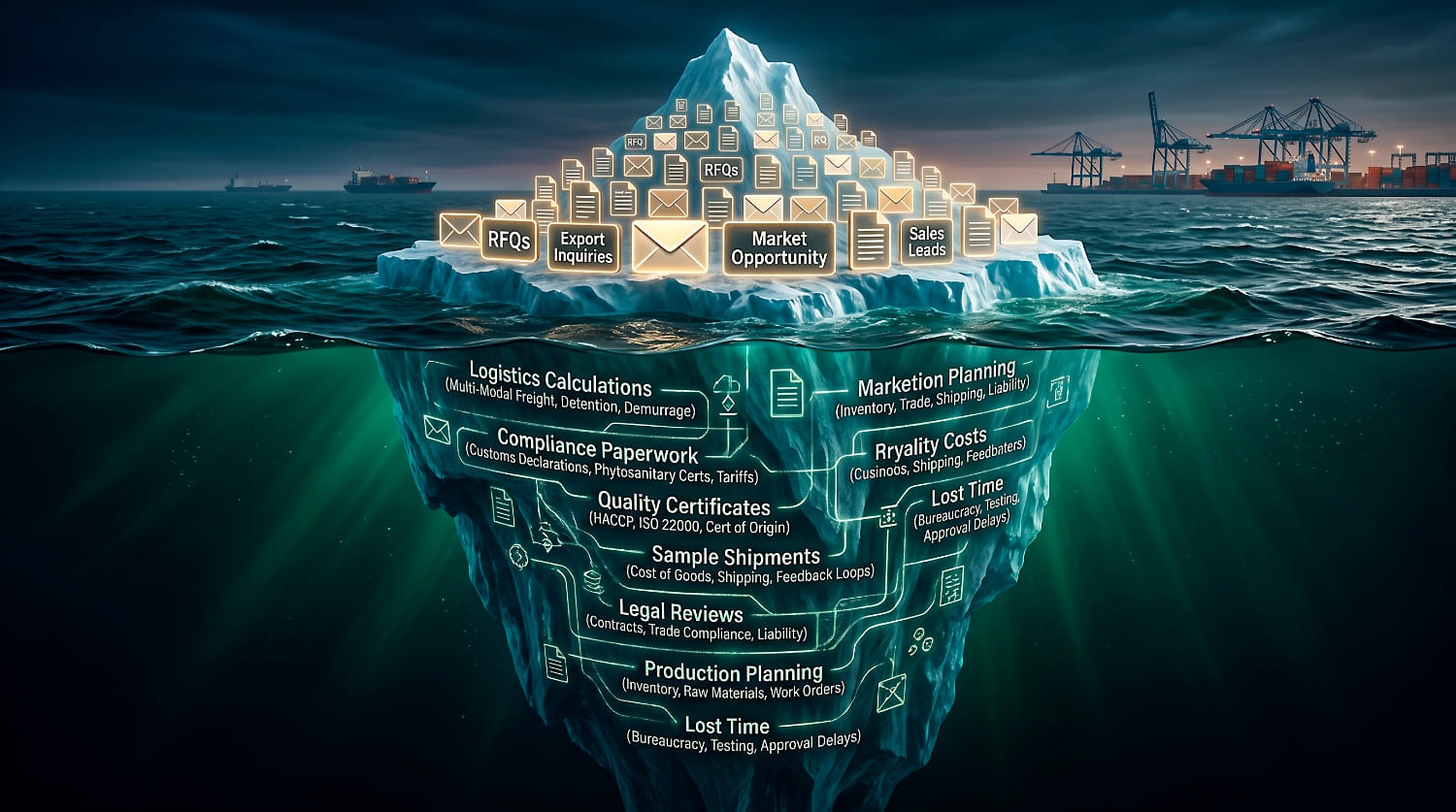
The era when the efficiency of an export department was measured by the gross volume of inbound emails has concluded. In the contemporary realities of global food trade, an excessive, unfiltered influx of inquiries is not a driver of growth, but rather a hidden threat to a company's operational efficiency. It dilutes the focus of the commercial team, destroys profitability through massive opportunity costs, and undermines response speed to inquiries from genuine, high-budget partners.
The main takeaway for top management is clear: a firm, timely rejection of ten questionable, vague, or unqualified inquiries today is the sole guarantee of preserving your export department's workweek to secure a major systemic contract tomorrow. Protecting company resources demands a transition from the extensive accumulation of contacts to intensive, automated, and platform-based demand filtering.
This approach is executed within modern specialized B2B platforms, such as AllFoods Market, where routine verification, compliance, and counterparty digital reputation tracking processes are automated at the infrastructure level. This enables manufacturers to completely liberate export teams from handling informational noise and focus their intellect on what matters most—product architecture, delivery quality, and scaling net profit.
When building systemic export sales, it is vital to remember: even an importer's successful progression through all verification stages does not guarantee an immediate contract signature. In the next article, we will examine the reverse side of the coin: why genuine, well-funded international buyers frequently ignore proposals from verified suppliers, and which hidden errors in the structure of an initial commercial offer permanently bar a manufacturer's entry to global retail chains.
Latest blog posts
-
Top 10 Supermarket Chains in Austria: A Brief Overview
Austria’s grocery retail market brings together national chains, international groups, discounter...
-
Top 10 Supermarket Chains in Belgium: A Brief Overview
Belgium’s grocery retail sector brings together national chains, international groups, discounter...
-
Olive Oil Producers in Spain for B2B Sourcing
Spain's olive oil sector combines cooperative mills, industrial processors, refiners, bottlers, a...
-
Top 10 Largest Grocery Chains in Italy
Italy’s grocery market is divided among cooperative groups, national supermarket brands, internat...
-
Top 10 Largest Grocery Chains in Sweden: A Brief Overview
An overview of Sweden's largest grocery retail chains, including store formats, geographic covera...


Categories
- Reviews of products and manufacturers
- Allfoods Market System Features
- Market Insights
- Food Technologies
Latest posts in partners' blogs
-
Uzbekistan Food Exports and Key Markets
Uzbekistan’s food exports are expanding well beyond fresh produce. Fruit, vegetables, flour, mung...
-
Kazakhstan Food and Agricultural Exports
Kazakhstan’s export offer extends well beyond wheat and other grains. International buyers can al...
-
Alpine Beef Ribeye: The Pinnacle of Flavor and Excellence for Your HoReCa and Retail Business
The Perfect Steak Starts with a Name: Alpine
-
Uganda Agricultural Exports and Key Products for B2B Sourcing
Uganda’s agricultural export profile is dominated by coffee, but the commercial picture is broade...
-
Food Exports from Morocco
Morocco’s food export profile extends well beyond citrus and olive oil. Fresh tomatoes, berries, ...